
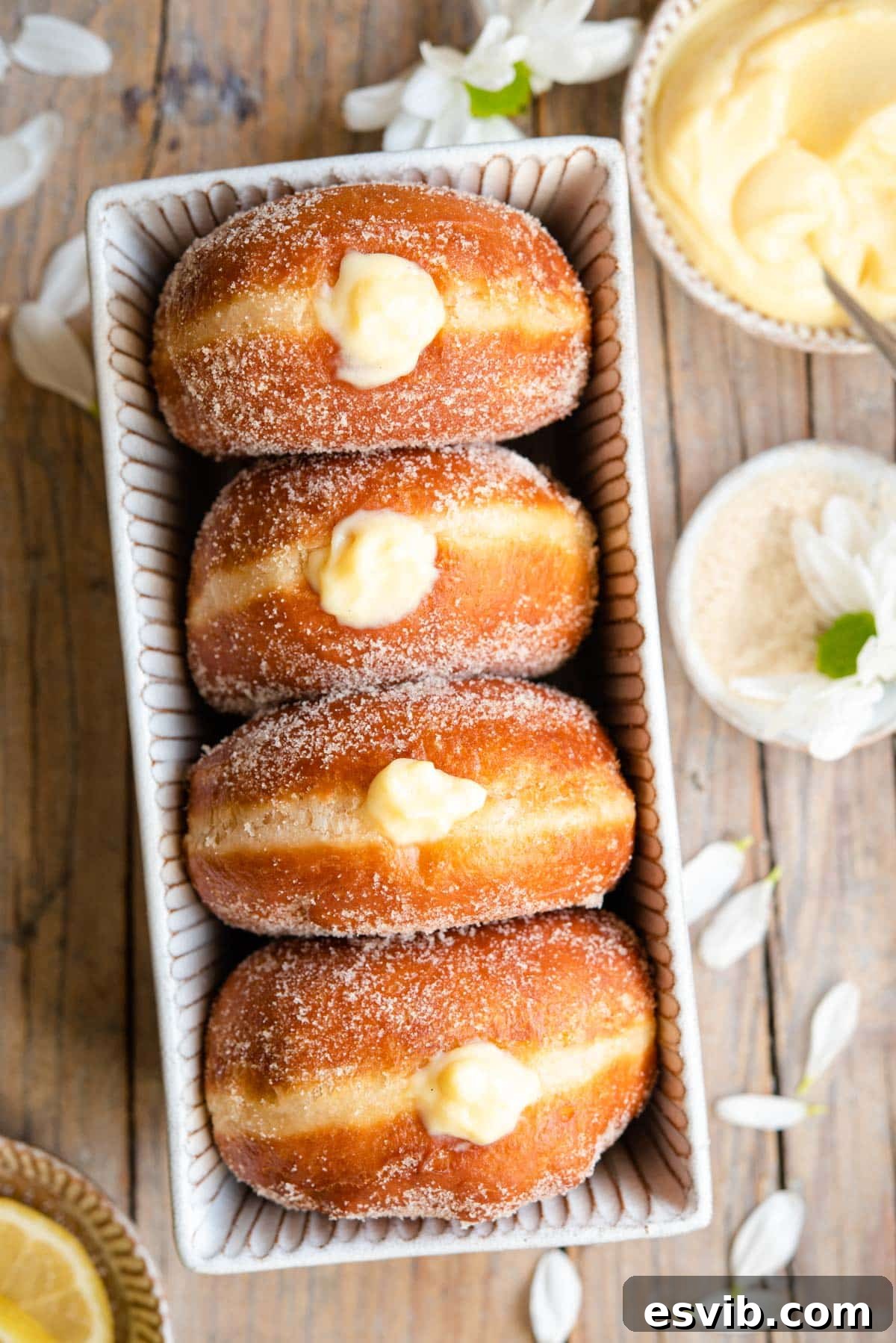
Indulge in the heavenly delight of **Italian Bomboloni Doughnuts**, a true taste of Italy right in your kitchen. These incredibly soft and light doughnuts are generously rolled in sparkling sugar and bursting with rich, silky Italian pastry cream (crema pasticciera). Each bite offers an explosion of sweetness and a wonderfully airy texture, making them an unforgettable treat for any occasion. Prepare to fall in love with these insanely delicious Italian pastries!
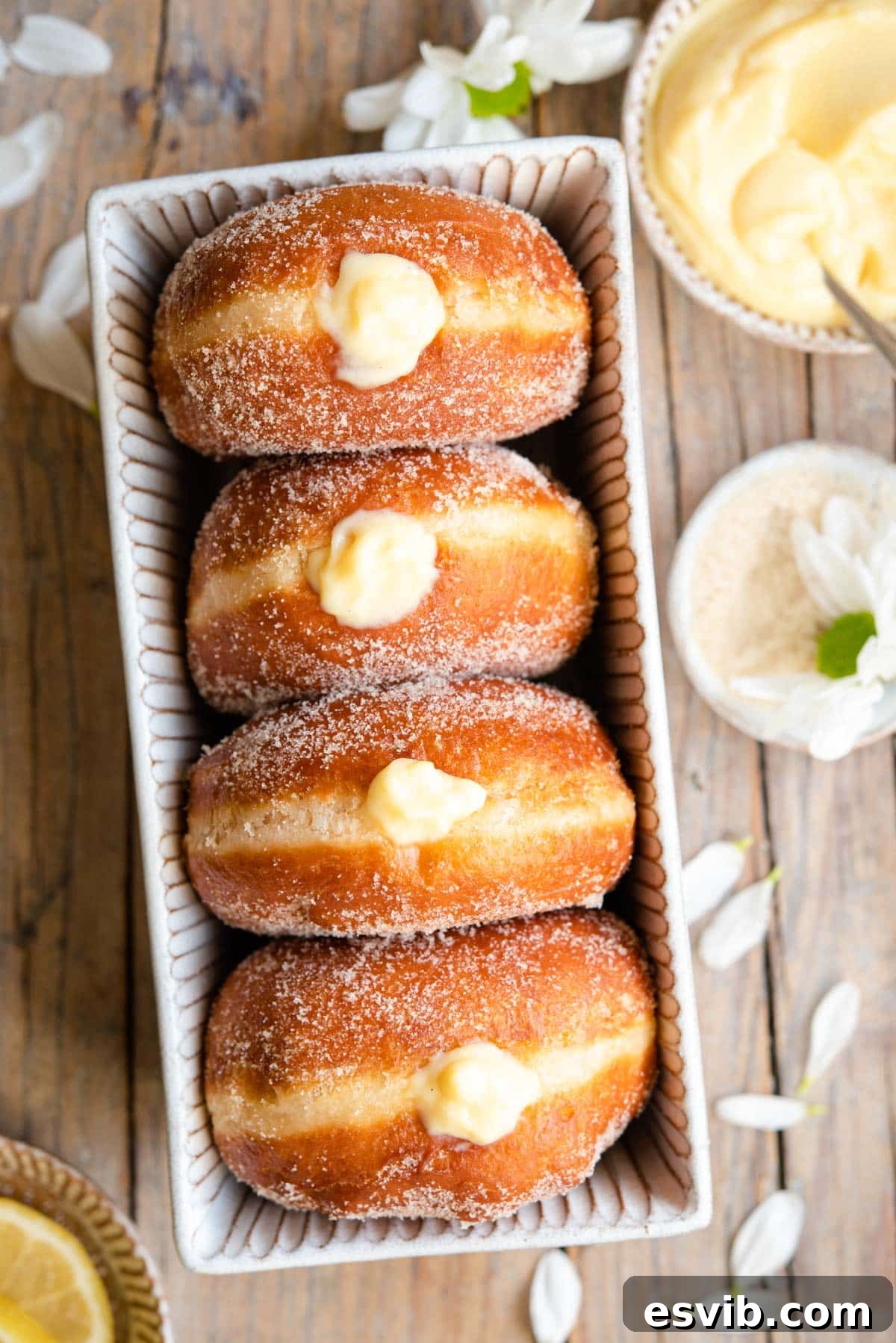
Is there anything quite as comforting and satisfying as biting into a fresh, warm doughnut? The answer is a resounding *yes* if that doughnut happens to be a Bomboloni, especially when it’s generously filled with thick, luscious, perhaps even limoncello-spiked Italian pastry cream. That, my friends, is pure culinary heaven, a small piece of Italy served on a plate.
My obsession with *crema pasticciera* knows no bounds. Whether it’s serving as the decadent filling for a classic Torta della Nonna, folded into whipped cream to create an ethereal layer cake filling, or piped lavishly into beloved Italian pastries like *cornetti* (Italian croissants) or these delightful bomboloni, its versatility and exquisite taste are simply unmatched.
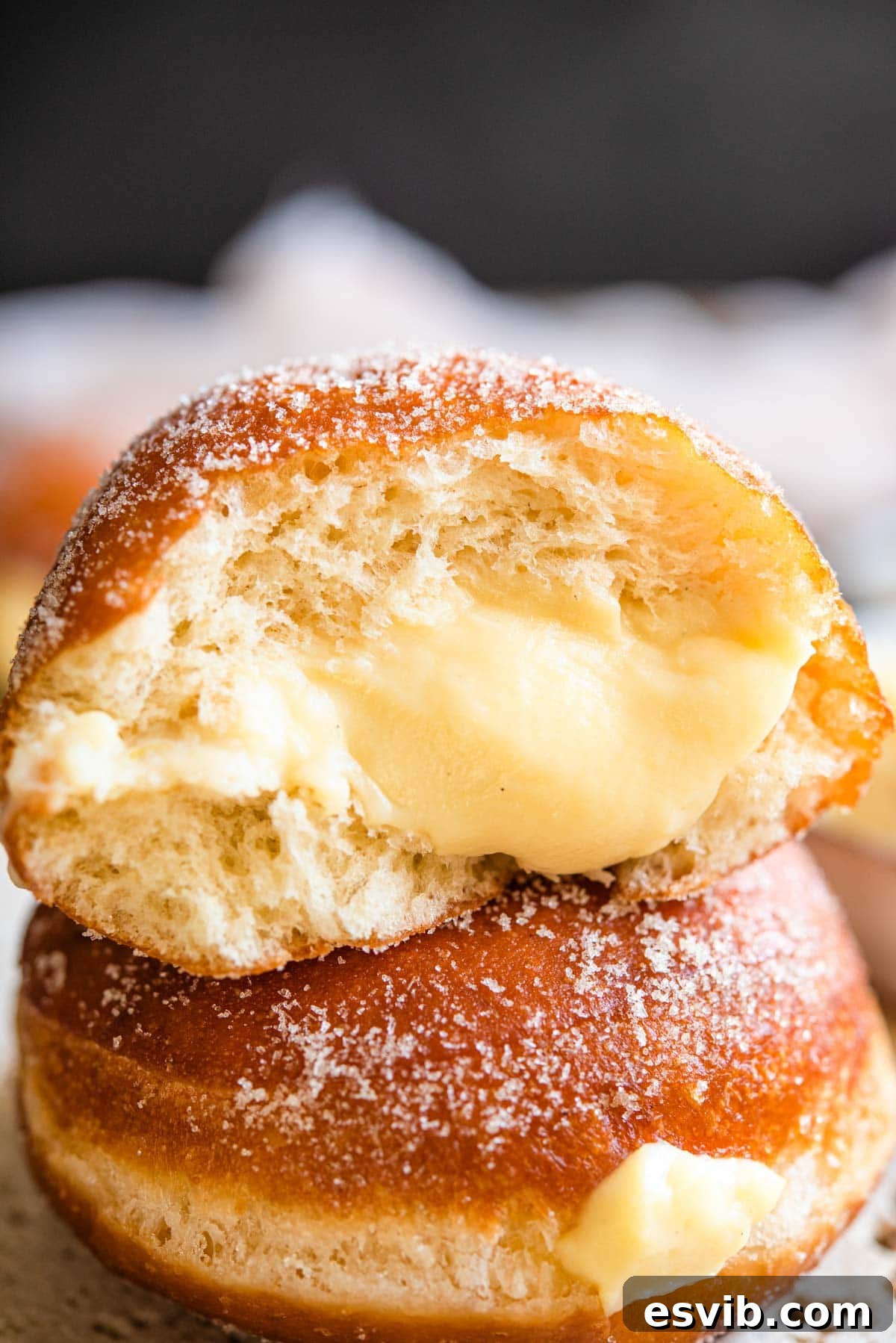
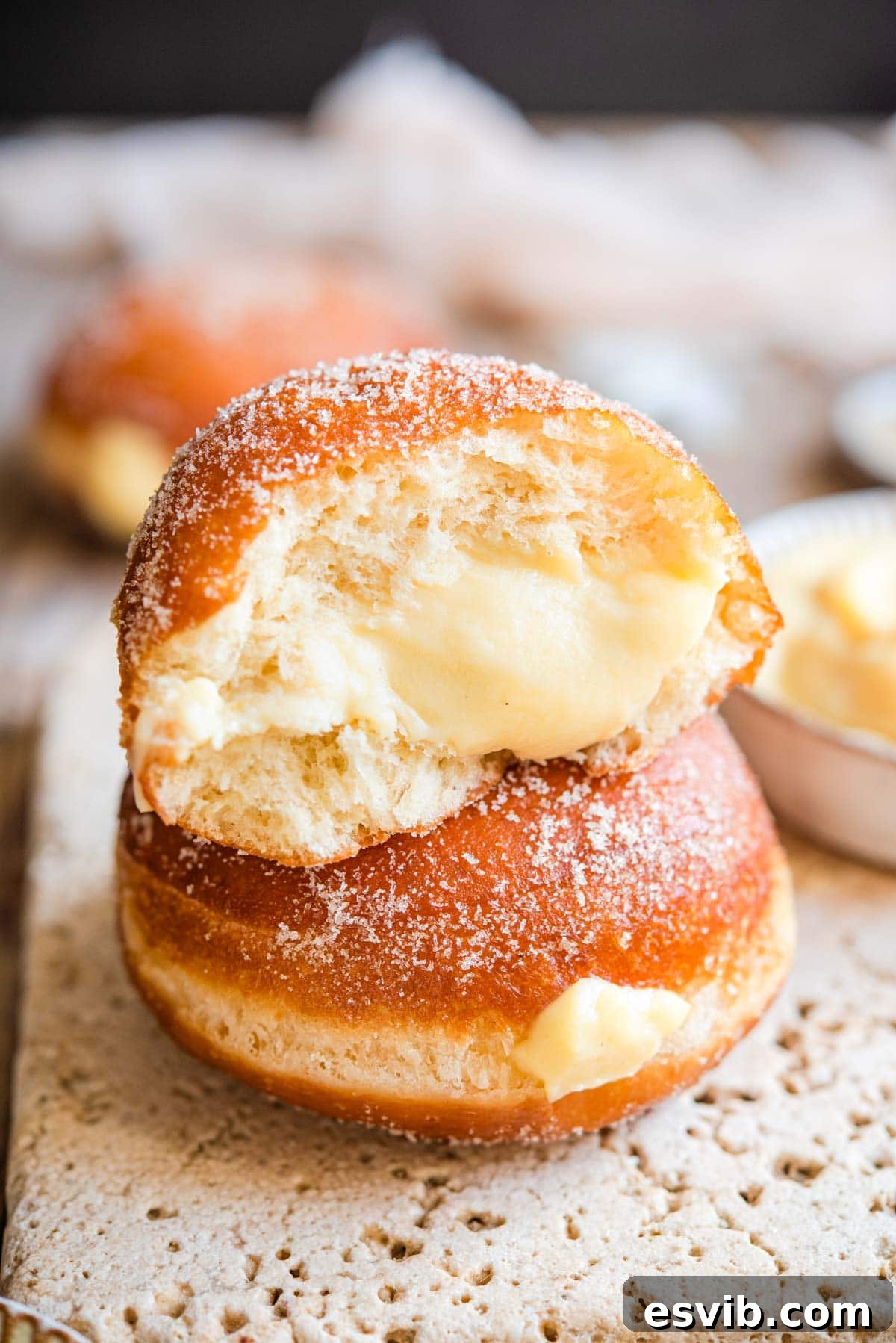
In Italy, bomboloni are a cherished morning indulgence, often enjoyed at local bars for breakfast alongside a steaming cappuccino. Much like *cornetti con crema*, these doughnuts are known for their abundant filling. They feel wonderfully substantial in your hand, yet surprise you with their incredibly light and airy texture once you take that first glorious bite. They are a testament to the Italian philosophy of savoring life’s simple pleasures.
Fun fact: The name “Bomboloni” literally translates to “big bombs.” This perfectly describes these plump, round doughnuts, jam-packed with an irresistible filling that explodes with flavor in every mouthful!
What are Italian Bomboloni Doughnuts? A Sweet Tradition
Bomboloni are essentially Italian filled doughnuts, traditionally found throughout Italy, particularly in Tuscany. Unlike their American counterparts, bomboloni are usually round, without a hole, and are meant to be generously filled with a creamy delight. They are typically deep-fried until golden, then rolled in granulated sugar while still warm. This creates a beautifully crisp, sweet exterior that gives way to an incredibly soft, tender interior. Their simplicity in ingredients belies the depth of flavor and texture they offer, making them a staple in Italian bakeries and a beloved breakfast or dessert item.
Why You’ll Love This Homemade Bomboloni Recipe
There’s something truly special about homemade doughnuts, and these Italian Bomboloni are no exception. This recipe guides you through creating doughnuts that are:
- **Incredibly Soft & Light:** Achieving that perfect pillowy texture is key.
- **Richly Flavored:** From the subtle vanilla notes in the dough to the luxurious pastry cream.
- **Perfectly Sweet:** Rolled in sugar for an irresistible crunch and glistening finish.
- **Versatile:** While traditional with *crema pasticciera*, we’ll explore other delicious filling ideas.
- **A Fun Baking Project:** A rewarding experience for both novice and experienced bakers.
Essential Ingredients for Perfect Bomboloni
Crafting these delectable Italian doughnuts requires a few simple, high-quality ingredients, mostly staples you’ll find in your pantry. Using fresh, room-temperature ingredients is crucial for the best results, ensuring optimal yeast activity and a smooth, well-emulsified dough.
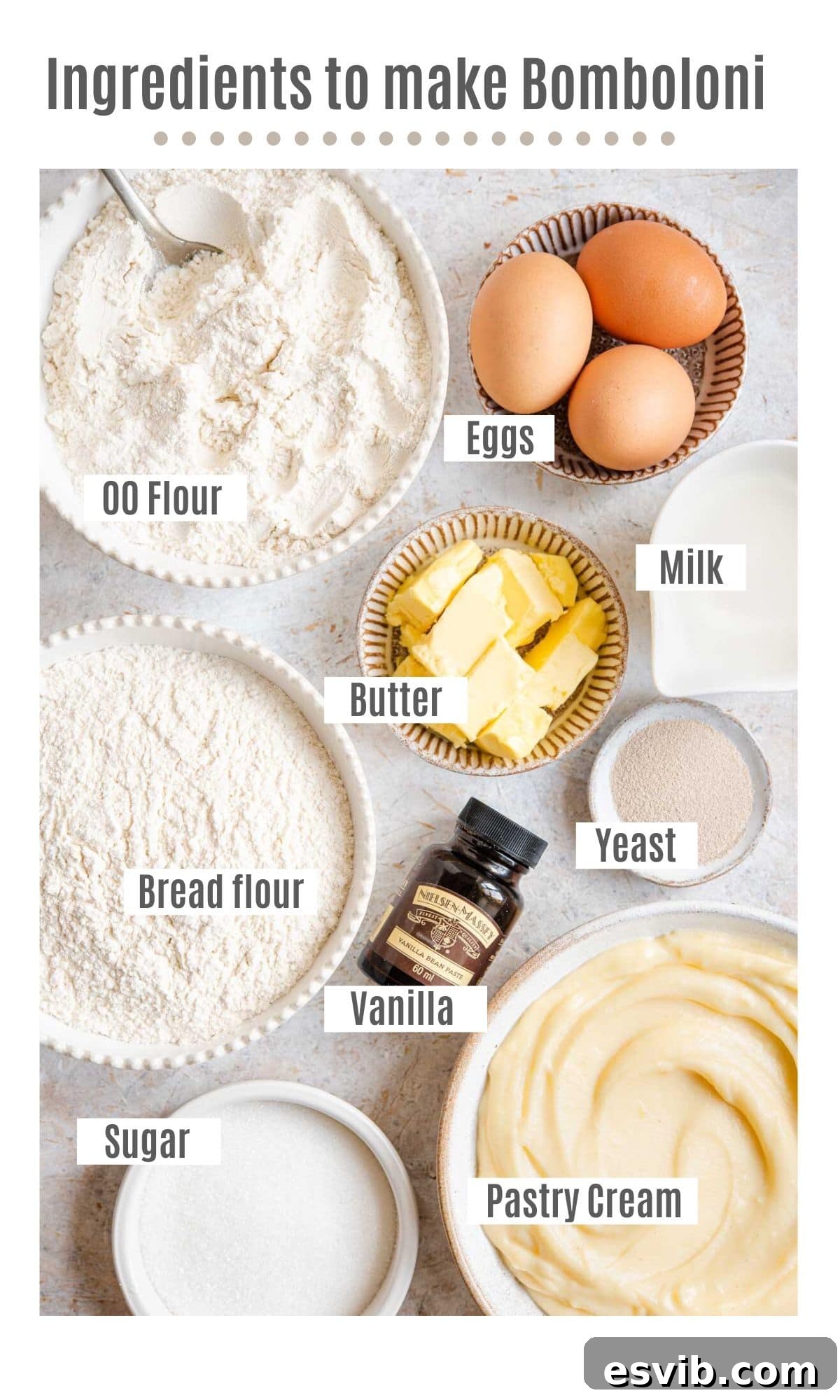
For the Bomboloni Dough
The foundation of a great bomboloni is its dough. Here’s what you’ll need:
- **Flour:** For the ultimate light and airy texture, a combination of **Italian 00 flour** and **strong bread flour** is recommended. 00 flour is finely milled, contributing to tenderness, while strong bread flour, with its higher protein content, develops excellent gluten for structure and chewiness. If 00 flour isn’t available, all-purpose flour can be used in its place.
- **Eggs:** Large, room temperature eggs add richness, moisture, and help bind the dough.
- **Butter:** Softened butter incorporates smoothly into the dough, contributing to its tender crumb and rich flavor. Using butter at room temperature is key for even distribution during kneading.
- **Milk:** Lukewarm milk activates the yeast and provides necessary moisture. Ensure it’s not too hot (which can kill the yeast) or too cold (which can inhibit it).
- **Sugar:** Granulated sugar not only sweetens the dough but also feeds the yeast, aiding in the fermentation process and helping the doughnuts brown beautifully.
- **Vanilla:** Vanilla paste or extract adds a lovely aromatic depth to the dough, complementing the sweet filling.
- **Fast-Action Yeast:** Also known as instant yeast, this type is incredibly convenient as it can be added directly to the dry ingredients without prior activation. Always check your yeast packet for specific instructions, as some varieties may require proofing in liquid first.
- **Salt:** A small pinch of salt balances the sweetness and enhances all the flavors in the dough.
- **Caster Sugar or Confectioners’ Sugar:** For rolling the fried doughnuts while they’re still warm, creating that iconic sugary coating.
- **Sunflower or Vegetable Oil:** A neutral-flavored oil with a high smoke point is essential for deep frying, ensuring a clean taste and golden finish.
For the Classic Italian Pastry Cream (Crema Pasticciera)
While the bomboloni dough is versatile for many fillings, *crema pasticciera* is the traditional choice and undeniably divine. You’ll need:
- **Egg Yolks:** Provide the rich color, custardy texture, and decadent flavor.
- **Milk:** The base of the cream, heated to infuse with flavor.
- **Cornstarch:** Acts as a thickening agent, giving the cream its characteristic smooth, spoonable consistency.
- **Sugar:** Sweetens the cream to perfection.
- **Vanilla Paste or Vanilla Bean:** Infuses the cream with an intense, aromatic vanilla flavor. A vanilla bean scraped directly into the milk yields the most authentic taste.
- **Lemon Zest:** A small amount of lemon zest adds a bright, fresh counterpoint to the richness of the cream, a hallmark of traditional Italian pastry cream.
Step-by-Step Guide: How to Make Bomboloni – From Dough to Delight
Making bomboloni is a rewarding process that involves a few key stages. Follow these detailed steps for perfect, bakery-quality Italian doughnuts at home.
Crafting the Silky Dough
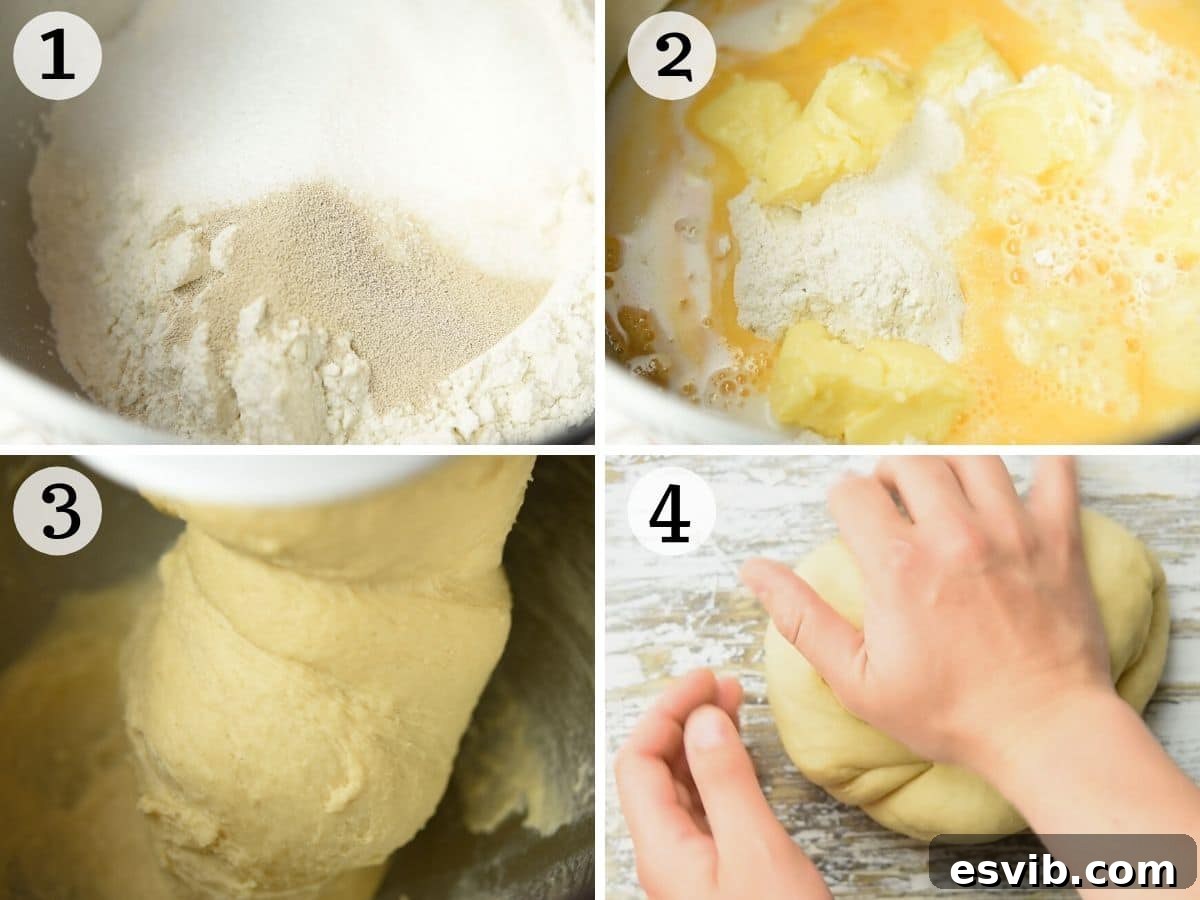
- **Combine Dry Ingredients:** In the bowl of a stand mixer, combine the bread flour, 00 flour (or all-purpose), granulated sugar, and fast-action yeast. Stir these dry ingredients together thoroughly to ensure even distribution of the yeast **(photo 1)**.
- **Add Wet Ingredients & Fat:** Scatter small cubes of softened butter evenly over the flour mixture. This helps the butter incorporate gradually. Pour in the room-temperature eggs, lukewarm milk, vanilla paste (or extract), and a small pinch of salt **(photo 2)**.
- **Knead to Perfection:** Attach the dough hook to your stand mixer. Begin kneading on a low speed (on a KitchenAid, speed 2 is ideal) for approximately 10 minutes. Resist the urge to increase the speed, as slow kneading helps develop the gluten without overheating the dough.
- **Check Dough Consistency:** After 10 minutes, the dough should transform into a smooth, elastic, and slightly tacky ball. It should pull away from the sides of the bowl but still feel soft and moist to the touch. Avoid adding extra flour at this stage unless the dough is excessively wet and sticky (see tips below) **(photo 3)**.
- **Form a Smooth Ball:** Lightly grease a clean work surface with a tiny bit of oil (avoiding extra flour is important here). Tip the dough out and gently knead it 2-3 times to shape it into a perfectly smooth ball **(photo 4)**.
Mastering the Perfect Proof
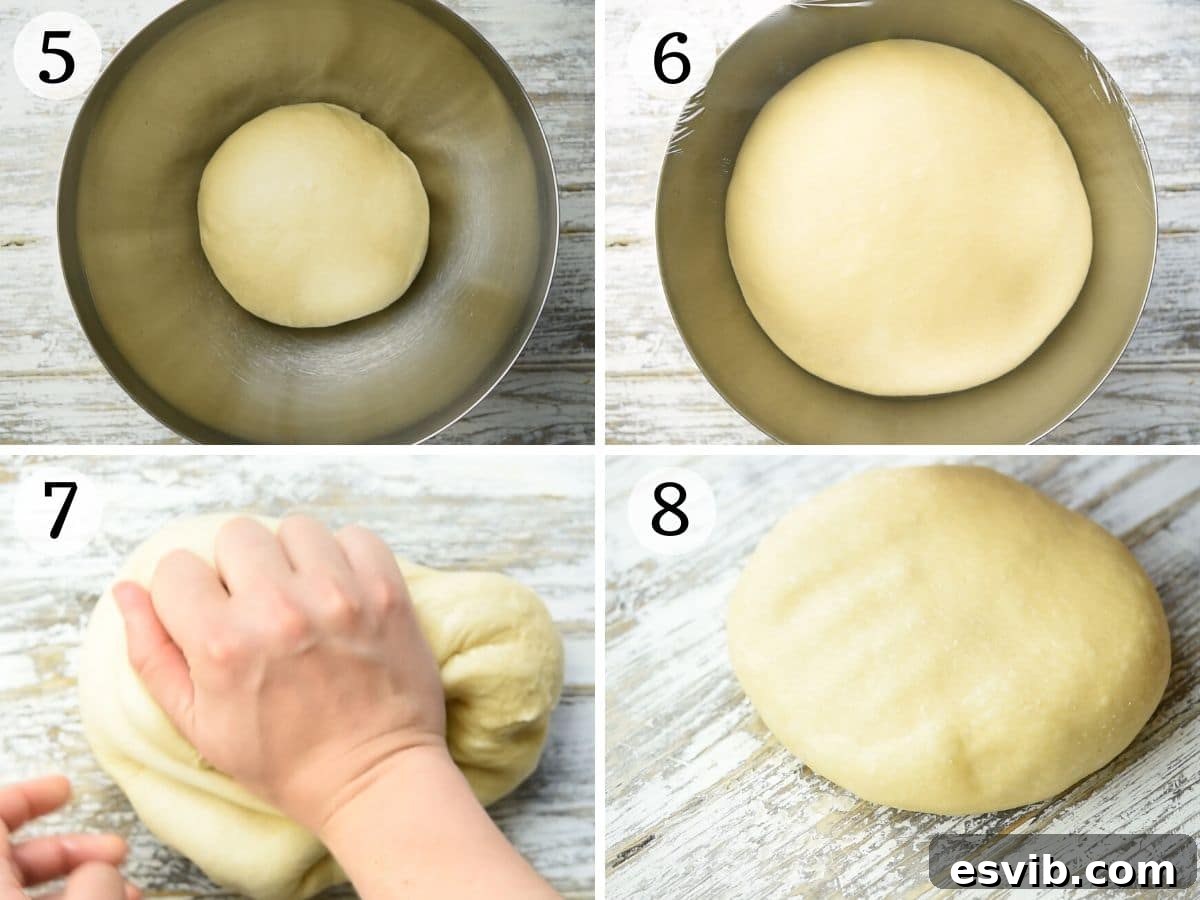
- **First Proof:** Place the smooth dough ball into a clean bowl that has been lightly greased with oil. Cover the bowl tightly with plastic wrap to prevent a skin from forming. Allow the dough to prove in a warm, draft-free place for 2-3 hours, or until it has at least tripled in size. This slow rise develops rich flavor and ensures a light texture **(photos 5 & 6)**.
- **Degas and Reshape:** Once the dough has proudly risen, gently tip it out onto your clean work surface. Carefully “knock out” or degas the air by pressing it down gently. Then, knead it a few times to reshape it into a smooth ball again **(photo 7)**.
- **Roll the Dough:** Using your hands, gently flatten the dough. Then, with a rolling pin, roll it out evenly into a rectangle about ½ inch (1.5cm) thick. Aim for uniform thickness to ensure even frying **(photos 8 & 9)**.
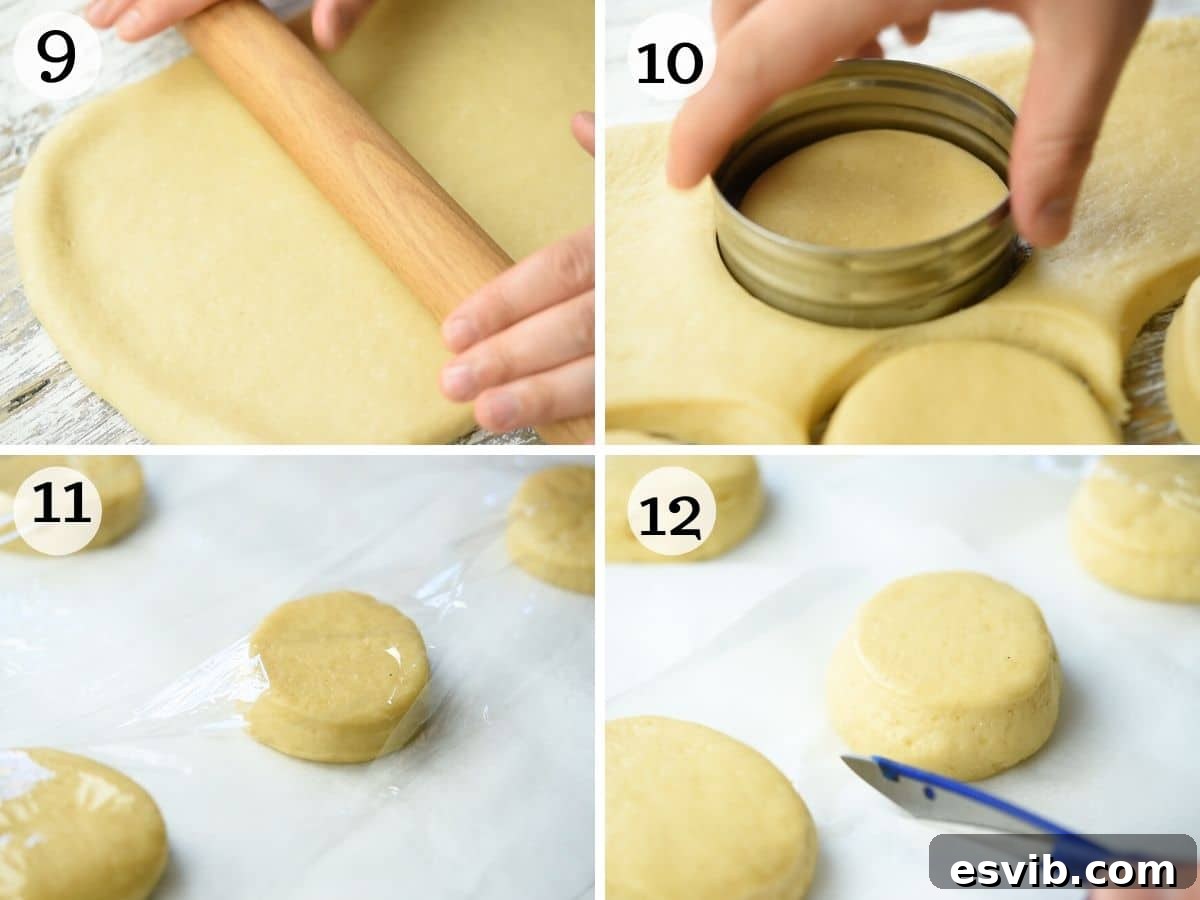
- **Cut Out Doughnuts:** Use a round cookie cutter (approximately 3.5 inches in diameter) or the rim of a glass to cut out individual doughnut rounds. Avoid twisting the cutter as this can seal the edges and prevent a good rise. Gather any dough scraps, gently re-knead them, and re-roll to cut out more doughnuts. You can also fry the scraps as delightful, irregularly shaped treats **(photo 10)**.
- **Second Proof:** Carefully transfer the cut-out doughnuts onto squares of baking parchment paper. This makes them easier to handle later. Arrange them on a baking sheet, leaving some space between each. Loosely cover them with plastic wrap. Let them prove for another 1-1.5 hours, or until they have doubled in size and feel light and puffy **(photo 11)**.
- **Prepare the Filling:** While your doughnuts are undergoing their second proof, prepare your Italian pastry cream (crema pasticciera) following the instructions below. Allow it to cool completely before using.
Frying Your Bomboloni to Golden Perfection
Frying is a crucial step to achieve the perfect golden exterior and light texture. Temperature control is paramount.
- **Heat the Oil:** When your doughnuts are well-proved and ready to fry, heat a large, deep pan or pot with at least 3 inches of sunflower or vegetable oil. Use a reliable kitchen thermometer to monitor the oil temperature, aiming for a steady 170°C (337°F). Maintaining this temperature is critical for evenly cooked, non-greasy doughnuts.
- **Prepare Doughnuts for Frying:** If you haven’t already, cut the baking parchment paper around each proved doughnut, so each one rests on its own individual square of paper **(photo 12)**. This parchment paper acts as a handle, allowing you to transfer the delicate dough into the hot oil without deflating it.
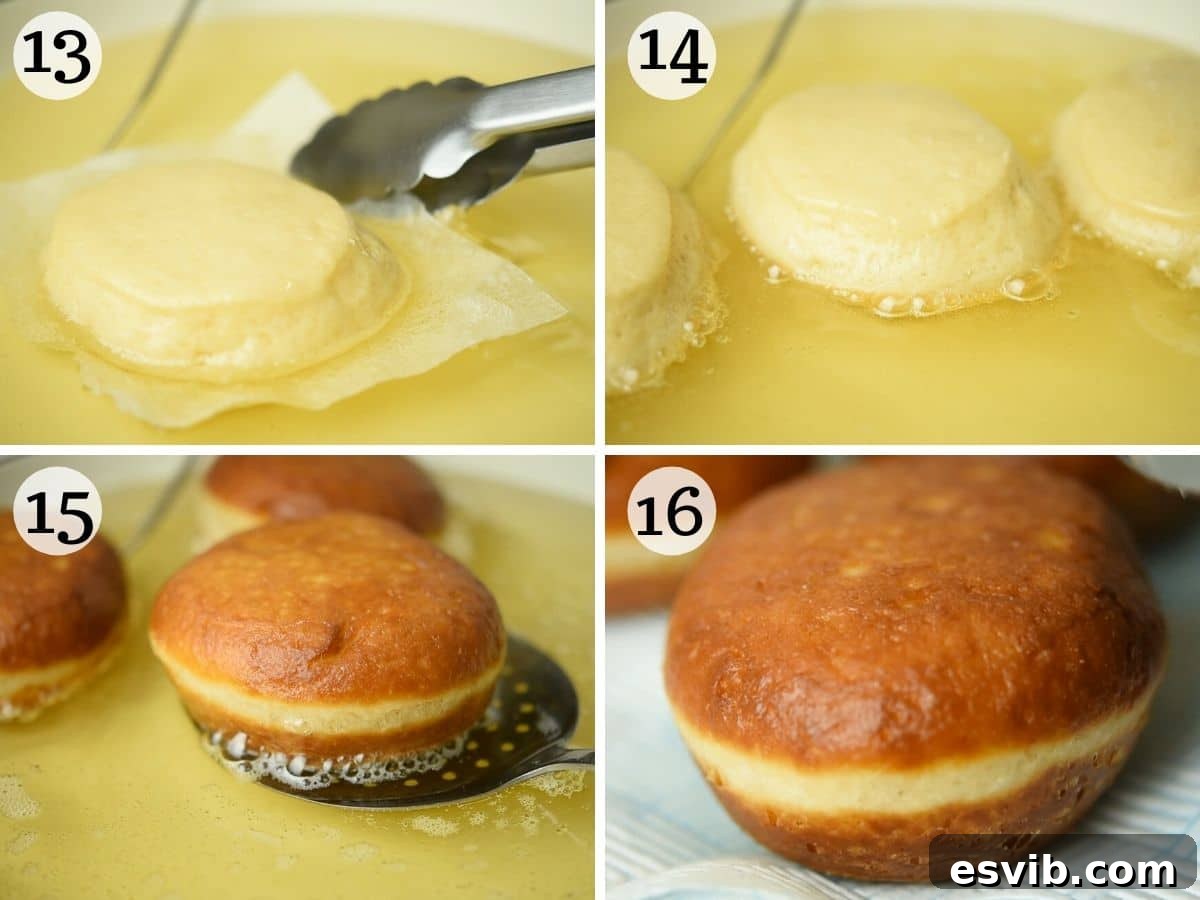
- **Careful Transfer:** Gently drop a doughnut, still on its parchment square, into the hot oil. After a few seconds, use tongs to carefully remove the parchment paper from the oil **(photo 13)**.
- **Fry in Batches:** Fry the doughnuts in small batches (2-3 at a time) to avoid overcrowding the pan. Overcrowding will drastically lower the oil temperature, leading to greasy, heavy doughnuts that don’t brown properly.
- **Flip and Fry:** Fry the doughnuts for about 2 minutes on one side until golden brown. Then, carefully flip them over with tongs and fry for another 2 minutes on the other side, until evenly golden and cooked through **(photos 14 & 15)**.
- **Drain and Sugar-Coat:** Using tongs or a slotted spoon, remove the fried doughnuts from the oil and place them on a plate lined with kitchen paper to drain excess oil for about 2 minutes. While they are still warm, gently roll them in caster sugar or confectioners’ sugar. The warmth helps the sugar adhere beautifully **(photo 16)**.
- **Cool Completely:** Place the sugar-coated bomboloni on a wire rack to cool completely before filling. Filling warm doughnuts will cause your pastry cream to melt.
Filling Your Delicious Doughnuts
Once cooled, your bomboloni are ready for their creamy heart.
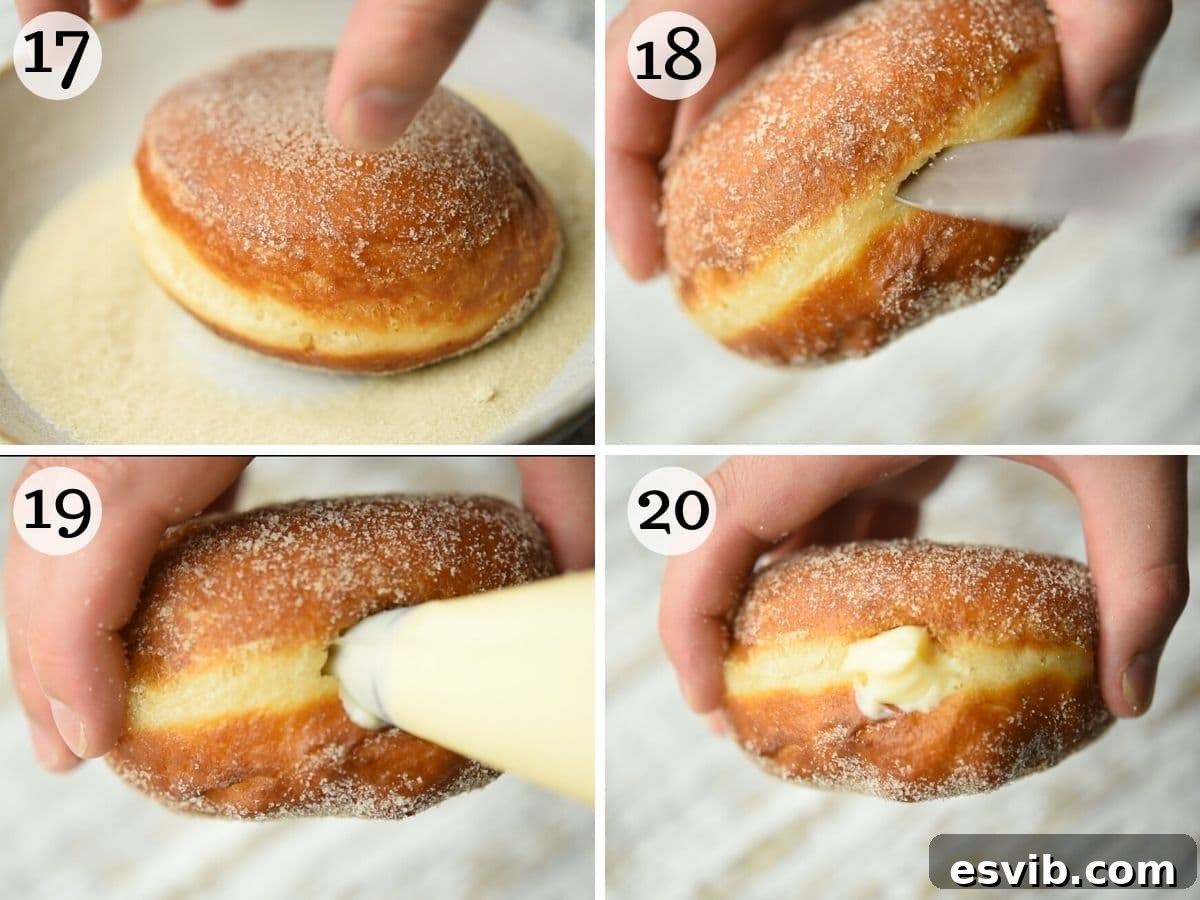
- **Make the Incision:** Take a small, sharp knife and carefully insert it into the side of a cooled doughnut. Gently move the knife around to create a small incision or pocket inside, making space for the filling **(photo 18)**.
- **Pipe the Filling:** Fill a piping bag fitted with a medium-sized, plain round nozzle (or a star tip for a decorative touch) with your cooled pastry cream or desired filling. Insert the nozzle into the incision and pipe generously until the doughnut feels delightfully heavy and full **(photos 19 & 20)**.
- **Serve and Enjoy:** Serve your freshly filled bomboloni immediately for the best experience.
Homemade Italian Pastry Cream (Crema Pasticciera): The Signature Filling
The heart of a traditional bomboloni is its exquisite *crema pasticciera*. Making it from scratch is simpler than you might think and yields a superior taste and texture.
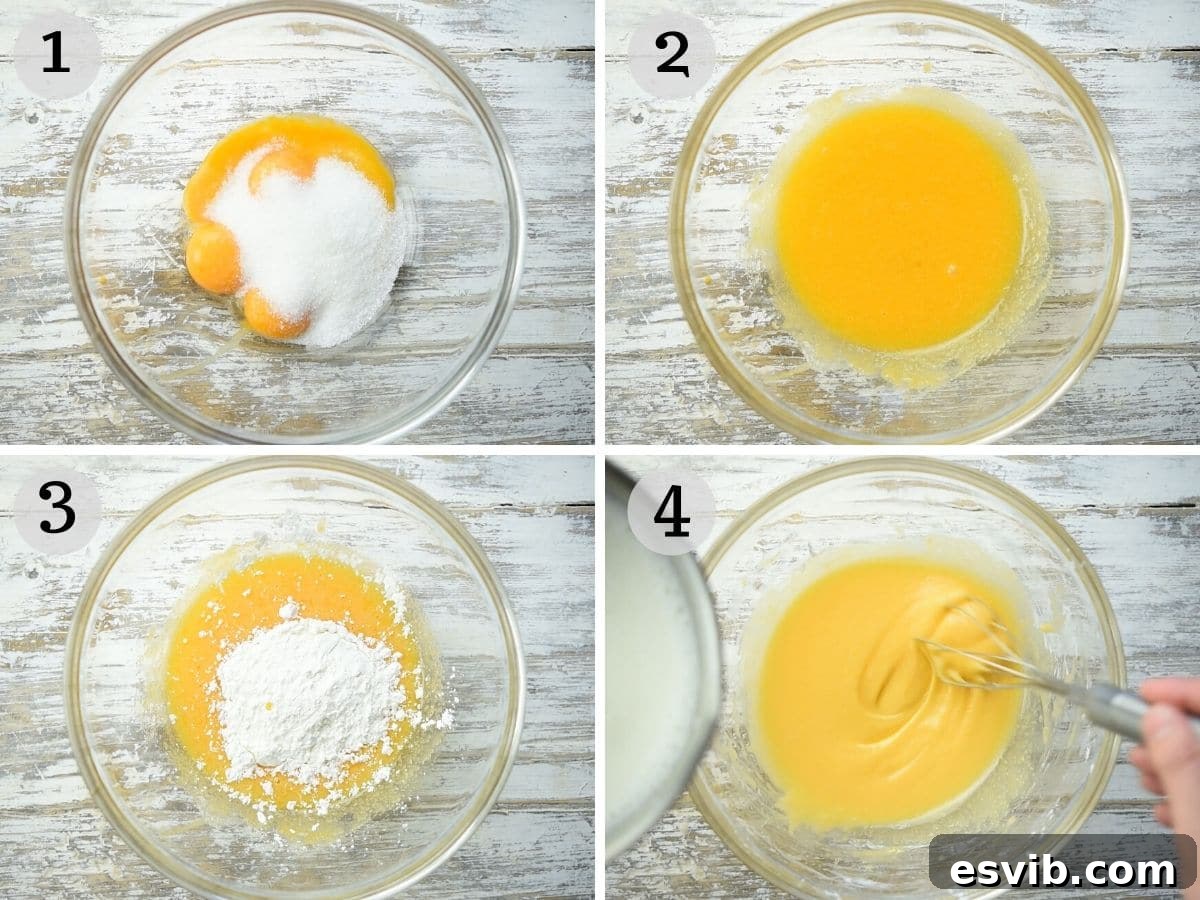
- **Whisk Yolks and Sugar:** In a large bowl, combine the egg yolks, granulated sugar, vanilla paste (or scraped vanilla bean seeds), and lemon zest. Whisk vigorously until the mixture is pale yellow and creamy, and the sugar is well incorporated.
- **Add Cornstarch:** Sift the cornstarch into the egg yolk mixture and whisk again until thoroughly combined and no lumps remain. This step is crucial for a smooth cream.
- **Heat the Milk:** In a saucepan, gently heat the milk over medium heat until it’s hot but not boiling. Just as small bubbles begin to form around the edges, remove it from the heat and let it sit for about 1 minute.
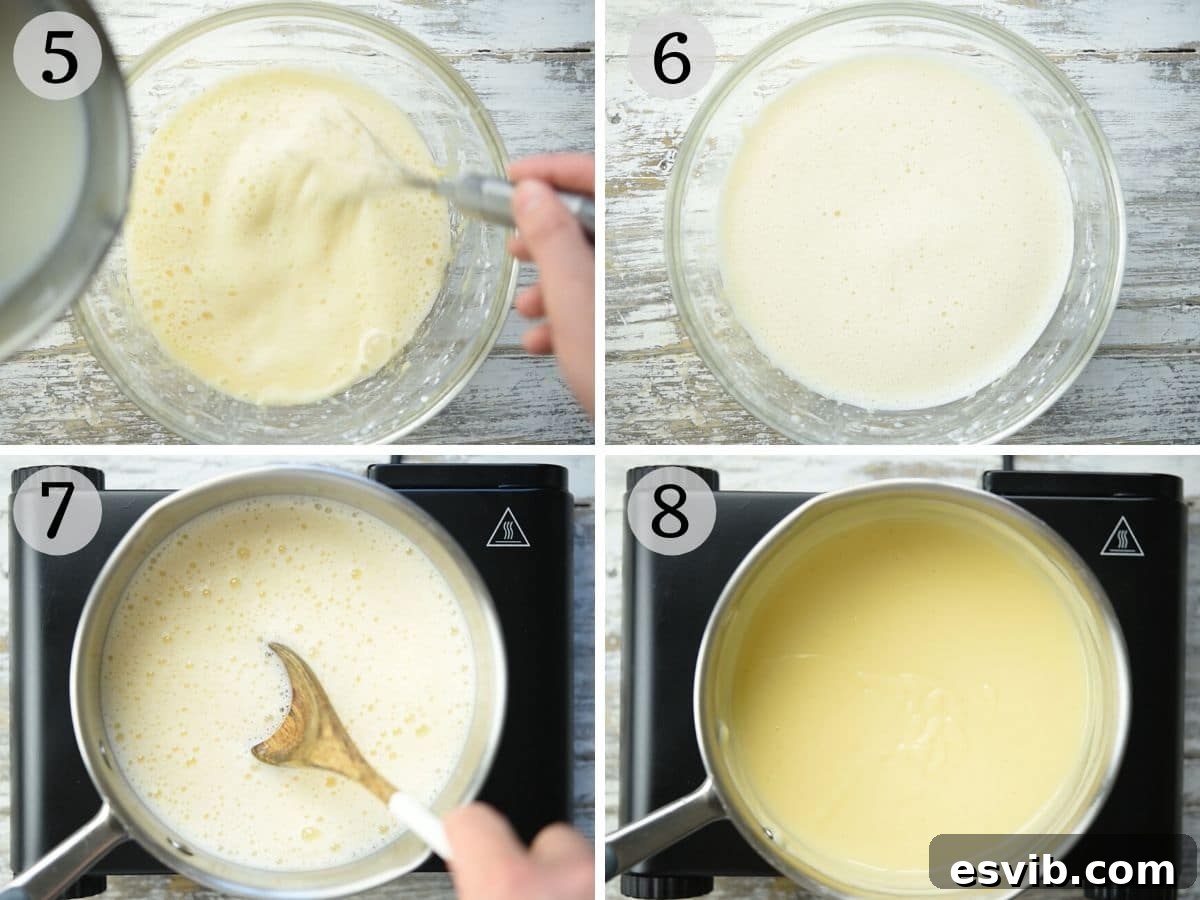
- **Temper the Eggs:** Slowly pour the hot milk into the egg yolk mixture in a thin, steady stream while constantly whisking. This “tempering” process gradually raises the temperature of the egg yolks, preventing them from scrambling. Continue whisking until the mixture is completely smooth and lump-free.
- **Thicken the Cream:** Pour the entire tempered mixture back into the saucepan. Heat it over low to medium-low heat, stirring constantly with a whisk or wooden spoon. It’s vital to stir continuously, scraping the bottom and sides of the pan, to prevent sticking and ensure even cooking. The cream will gradually thicken, becoming lusciously rich and creamy. This process typically takes 10-15 minutes. The mixture needs to be quite thick; don’t be tempted to turn up the heat quickly, as this can scramble the eggs.
- **Cool the Pastry Cream:** Once the cream is thick and glossy, remove it from the heat and immediately transfer it to a clean bowl. To prevent a “skin” from forming on top, press a piece of plastic wrap directly onto the surface of the cream. Allow it to cool completely at room temperature, then refrigerate for at least 2 hours (or until thoroughly chilled and firm enough for piping) before filling your bomboloni. For a more comprehensive guide on how to make perfect Crema Pasticciera, check out our dedicated Italian Pastry Cream Recipe!
Beyond Crema Pasticciera: Exciting Bomboloni Filling Variations
While traditional Italian pastry cream is a classic for a reason, bomboloni are wonderfully versatile and can be filled with a variety of delicious alternatives. Don’t hesitate to experiment with these tempting options:
- Chocolate Spread: A universally loved choice! If you prefer to avoid palm oil, consider making our super easy recipe for homemade Nutella-style chocolate spread for an even richer, healthier alternative.
- Fruit Jam or Preserve: From bright and tangy raspberry or strawberry jam to sweet apricot or blackberry preserves, fruit fillings offer a delightful contrast to the rich doughnut. Choose a high-quality jam for the best flavor.
- Whipped Cream: Simple, light, and utterly delicious. Sweetened whipped cream provides an airy texture that melts in your mouth, a perfect choice for those who prefer a less rich filling.
- Dulce de Leche or Caramel Cream: For a deeper, more indulgent sweetness, dulce de leche or a homemade salted caramel cream makes for an incredible filling, offering a buttery, toffee-like flavor.
- **Lemon Curd:** A vibrant and zesty option that beautifully cuts through the richness of the fried dough, perfect for citrus lovers.
- **Ricotta Cream:** A traditional Sicilian filling, often lightened with a touch of sugar and cinnamon, providing a creamy, delicate texture.
Expert Tips for Bomboloni Success
Achieving bakery-perfect bomboloni at home is entirely possible with a few key techniques and considerations:
- Accurate Flour Measurement: If you’re measuring flour by cups, **always spoon the flour into the cup** and then level it off gently without packing. Tapping the cup lightly can help settle the flour. For the most accurate results, a kitchen scale is highly recommended, as cup measurements can vary significantly.
- Dough Consistency is Key: The dough should be smooth, elastic, and slightly tacky. It should not be overly wet or stick heavily to your hands. If it feels too wet, add flour one tablespoon at a time, allowing it to absorb fully before adding more, until the desired consistency is reached.
- Kneading with a Stand Mixer: If using a stand mixer, keep the speed low (KitchenAid speed 2 is often perfect) to avoid over-kneading, which can make the dough tough. Knead for the recommended time, letting the machine do the work.
- The “White Ring” Phenomenon: The coveted white ring around the middle of a bomboloni (or any doughnut) indicates perfect proofing and frying. It means the doughnut was light enough to float on top of the oil as it fried. If your doughnuts lack this ring, it might be due to under-proofing or a dough that’s too heavy (incorrect wet-to-dry ingredient ratio).
- Oil Depth for Frying: For best results, ensure your frying oil is at least 3 inches deep. This allows the doughnuts to float and cook evenly, developing that ideal white ring.
- Maintain Oil Temperature: Use a sugar or deep-fry thermometer to keep the oil at a steady 170°C (337°F). If the oil is too hot (above 175°C/347°F), the doughnuts will brown quickly on the outside but remain raw inside. If the oil is too cool, they will absorb too much oil, becoming greasy and heavy.
- Avoid Overcrowding the Pan: Fry bomboloni in small batches. Adding too many at once will significantly drop the oil temperature, leading to undesirable results. Frying in batches also makes it safer and easier to manage each doughnut.
- Sugar-Coat While Warm: It is crucial to roll the fried doughnuts in sugar while they are still warm (after draining for a minute or two). The residual warmth and slight tackiness help the sugar adhere perfectly, creating a beautiful, sweet crust.
- Cool Before Filling: Always allow your bomboloni to cool completely before piping in the filling. Hot doughnuts will melt the pastry cream or any other delicate filling, leading to a messy and less enjoyable result.
- **Parchment Paper Trick:** The individual squares of parchment paper are not just for easy transfer; they help maintain the delicate round shape of the proved doughnuts. Handling them directly can easily knock out the precious air built up during proofing.
Bomboloni Making FAQs
While a stand mixer with a dough hook makes the kneading process significantly easier and more consistent, it’s absolutely possible to make bomboloni dough by hand. If kneading by hand, you’ll need to dedicate at least 10-15 minutes to vigorous kneading. Start by mixing all ingredients in a large bowl with a wooden spoon until a shaggy dough forms. Then, turn it out onto a lightly floured (or oiled) clean work surface and begin kneading. The dough will initially be quite sticky, but resist the temptation to add too much extra flour. As the gluten develops through kneading, the dough will become smooth, elastic, and much less sticky.
The distinctive white ring, often referred to as the “halo,” is a hallmark of a perfectly fried doughnut. It forms because the doughnut is light enough to float, causing the middle section to be slightly out of the hot oil, thus cooking less. To achieve this, ensure your dough is properly risen and light after the second proof. Also, maintaining the correct oil temperature (170°C/337°F) is crucial, as too low a temperature might cause the dough to sink, and too high a temperature can cook the outside too fast without enough lift.
I highly recommend using a neutral-flavored oil with a high smoke point for frying bomboloni. Sunflower oil is my preferred choice due to its very light flavor and ability to withstand high temperatures without breaking down. Vegetable oil (such as canola or grapeseed oil) is also an excellent option. Avoid oils with strong flavors (like olive oil) or those with low smoke points, as they can impart undesirable tastes and burn easily, affecting the quality of your doughnuts.
The optimal temperature for frying bomboloni is 170°C (337°F). It’s incredibly important to use a reliable kitchen thermometer to monitor and maintain this temperature. If the oil goes above 175°C (347°F), the doughnuts will brown too quickly on the outside before the inside has a chance to cook through. Conversely, if the oil temperature is too low, the doughnuts will absorb excessive oil, resulting in a greasy, heavy, and unpleasant texture. A consistent temperature ensures beautifully golden, light, and fluffy bomboloni.
Like most freshly fried doughnuts, bomboloni are absolutely best enjoyed on the same day they are made, ideally warm and fresh from the fryer. If you have unfilled doughnuts, you can store them in an airtight container at room temperature for 1-2 days, but they will gradually start to dry out. Filled bomboloni, particularly those with *crema pasticciera*, tend to stay moist a little longer due to the filling. Store filled doughnuts in a sealed container in the refrigerator for 1-3 days. Bring them to room temperature before serving for the best texture and flavor.
Serving and Pairing Suggestions
Bomboloni are a treat best savored fresh. Enjoy them warm or at room temperature. For an authentic Italian experience, pair them with a rich espresso or a frothy cappuccino. They also make a fantastic dessert alongside a glass of dessert wine, or simply as a luxurious afternoon snack with tea. Don’t forget that the visual appeal is part of the experience; arrange them artfully on a platter for maximum impact!
More Irresistible Italian Desserts You Might Like
If you have a sweet tooth and a love for Italian flavors, explore these other delightful recipes:
- Mini Cannoli – Perfect For Parties
- Torta della Nonna: Italian Custard Tart
- Quick & Easy Tiramisu – Best Ever Recipe
- White Chocolate Panna Cotta
- Italian Affogato Recipe – Ice Cream And Coffee
- Lady’s Kisses – Baci di Dama (Italian Cookies)
If you tried this Bomboloni Recipe or any other recipes on my blog, please be sure to leave me a comment below to let me know how you got on, I love hearing from you. You can also FOLLOW ME on FACEBOOK, INSTAGRAM and PINTEREST to see more delicious food and what I’m getting up to.
Step By Step Photos Above
Most of our recipes come with step by step photos, helpful tips and tricks to make it perfectly first time!
Bomboloni – Italian Doughnuts
By Emily

Equipment
- Sugar thermometer, for frying the oil
- Piping bag and medium sized nozzle
- Large round cookie cutter about 3.5 inch diameter
- Stand mixer with dough hook (optional, can be done by hand)
Ingredients
For the bomboloni dough
- 2 cups strong bread flour, (280g) see notes
- 2 cups 00 flour or all-purpose flour, (280g) see notes
- 3 large eggs, at room temperature
- 6.5 tbsp butter, softened (90g)
- 1/2 cup granulated sugar, (100g)
- 1/2 cup lukewarm milk, (120ml)
- 1/2 tsp vanilla paste, or 1 tsp vanilla extract
- 2 1/4 tsp fast action yeast, (7g)
- 1 small pinch of salt
- 2-3 tbsp caster sugar or confectioners sugar, for rolling doughnuts in
- Sunflower or vegetable oil, for frying (approx. 3 inches deep in pan)
For the pastry cream (if using)
- 5 egg yolks
- 2.5 cups milk, (½ litre)
- ¼ cup cornstarch, (30g)
- ⅓ cup sugar, (70g)
- ½ tsp vanilla paste or 1 vanilla bean (scraped)
- Zest of 1 lemon
Instructions
Before starting this recipe
- Please check the instructions on your yeast packet. Some yeast can be added straight to the dry ingredients (like we have done in this recipe) and others need to be activated in a little lukewarm liquid first. If this is the case, you can activate it in a little of the lukewarm milk from the recipe; do not add extra liquid.
How to make the Bomboloni dough
- Put the strong bread flour, 00 flour (or all-purpose), sugar, and fast-action yeast in the mixer bowl. Stir to combine thoroughly.
- Scatter cubes of softened butter over the flour mixture. Pour in the eggs, lukewarm milk, vanilla, and salt.
- Attach a dough hook attachment to the mixer. Knead on a low speed for 10 minutes (on a KitchenAid mixer, use speed 2).
- After 10 minutes, the dough should be smooth, elastic, and slightly tacky (refer to recipe notes 1 & 2 for guidance on dough consistency, especially if using cups).
- Tip the dough out onto a clean work surface (lightly oiled, avoid extra flour if possible). Shape the dough into a smooth ball by kneading it gently 2-3 times.
- Place the dough in a clean bowl lightly greased with oil. Cover tightly with plastic wrap. Leave to prove in a warm place for 2-3 hours, or until it has tripled in size.
- Once the dough has risen, gently tip it out onto your clean work surface. Knock out the air by gently pressing it down, then knead it a few times back into a smooth ball.
- Flatten the dough with your hands, then roll it out evenly into a rectangle about ½ inch (1.5cm) thick.
- Use a 3.5-inch diameter cookie cutter or glass to cut out round doughnuts. You can cut the scraps into random shapes for frying, or gently re-knead and re-roll them to cut out more doughnuts.
- Place the cut-out doughnuts on individual squares of baking parchment paper. Arrange them on a baking sheet and cover loosely with plastic wrap. Leave to prove for another 1-1.5 hours, or until they have doubled in size and are puffy.
- While the doughnuts are proving for the second time, prepare the pastry cream (directions below) and ensure it cools completely.
Frying the Bomboloni
- When ready to fry, heat a large, deep pan or pot with at least 3 inches of sunflower or vegetable oil until it reaches a steady 170°C (337°F). Use a thermometer to monitor.
- Carefully drop the proved doughnuts, still on their parchment paper squares, into the hot oil. Immediately remove the parchment paper with tongs.
- Fry the doughnuts in small batches (do not overcrowd the pan) for about 2 minutes on one side until golden brown.
- Flip the doughnuts over with tongs and fry for another 2 minutes on the other side until evenly golden and cooked through.
- Remove the fried doughnuts from the oil and drain on kitchen paper for around 2 minutes. While still warm, roll them generously in caster sugar or confectioners’ sugar.
- Place the sugar-coated bomboloni on a wire rack and leave to cool completely before filling.
How to fill the doughnuts
- To fill the bomboloni, insert a small, sharp knife into the side of a cooled doughnut and gently move it around to make a small pocket or incision inside.
- Fill a piping bag fitted with a medium round nozzle with the cooled pastry cream or your desired filling. Insert the nozzle into the incision and pipe generously until the doughnut feels full.
- Serve immediately for the best results.
To make Italian pastry cream (crema pasticciera)
- In a large bowl, put the egg yolks, sugar, vanilla (paste or scraped bean), and lemon zest. Whisk until well combined and pale.
- Add the cornstarch and whisk again until thoroughly combined and lump-free.
- Heat the milk in a saucepan until hot (just before boiling). Turn off the heat and let it sit for 1 minute.
- Slowly pour the hot milk into the egg yolk mixture while constantly whisking. This tempers the eggs and prevents scrambling.
- Pour the entire mixture back into the saucepan. Heat on a low to medium-low heat, stirring constantly, until thick and creamy (about 10-15 minutes). The mixture needs to be very thick. Do not be tempted to turn up the heat or the eggs will scramble.
- Once thick, turn off the heat and pour the pastry cream into a clean bowl. Press plastic wrap directly onto the surface of the cream to prevent a skin from forming. Leave to cool completely, then chill in the refrigerator before piping.
Notes
- If you are using cups to measure the flour: you must spoon the flour into the cup then lightly tap the cup until the flour has settled and leveled. This is important to achieve as accurate a weight as possible. A kitchen scale is recommended for accuracy.
- Texture of dough if using cups: there can be around 20-30g difference when measuring flour with cups. The dough should be tacky to touch and shouldn’t be wet or stick excessively to your hands. If you find the dough is wet and sticky, add 1 tbsp of flour at a time, allowing it to absorb into the dough until the dough is at the right consistency – smooth and elastic.
- The parchment paper helps keep the doughnuts nice and round; you can easily knock air out of the delicate dough if you handle them directly without it.
- If using a stand mixer keep it on a low-speed setting to avoid over-kneading the dough (KitchenAid speed 2 is usually sufficient).
- The oil should be around 3 inches deep for best results when frying.
- Try not to overcrowd the pan when frying, as the oil temperature will drop when you add more dough. Fry the doughnuts in batches to maintain temperature and make it easier and safer to remove them.
- Drain the fried doughnuts on kitchen paper for about 2 minutes to allow them to drain properly, then roll in sugar whilst still warm. If you don’t do this when the doughnuts are warm, the sugar won’t stick.
- Wait until the bomboloni are cooled before filling them. This prevents the filling from melting and oozing out.
Helpful Info for All Recipes
- I always use extra virgin olive oil in all of my savory recipes unless stated otherwise.
- When I use canned or jarred tomatoes of any kind, I always use Cirio or Mutti brands for the best results and flavor.
- All vegetables are medium sized unless stated otherwise.
- All recipes are tested and developed using a fan (convection) oven.
- Find out more about how nutrition is calculated.
- Check out our must-have Italian Pantry Staples.
- You can also find all our Essential Kitchen Tools for Italian Cooking.
Nutrition
Carbohydrates: 61g |
Protein: 12g |
Fat: 14g |
Saturated Fat: 8g |
Cholesterol: 181mg |
Sodium: 125mg |
Potassium: 187mg |
Fiber: 2g |
Sugar: 21g |
Vitamin A: 560IU |
Calcium: 112mg |
Iron: 2mg
Nutrition information is automatically calculated, so should only be used as an approximation.