
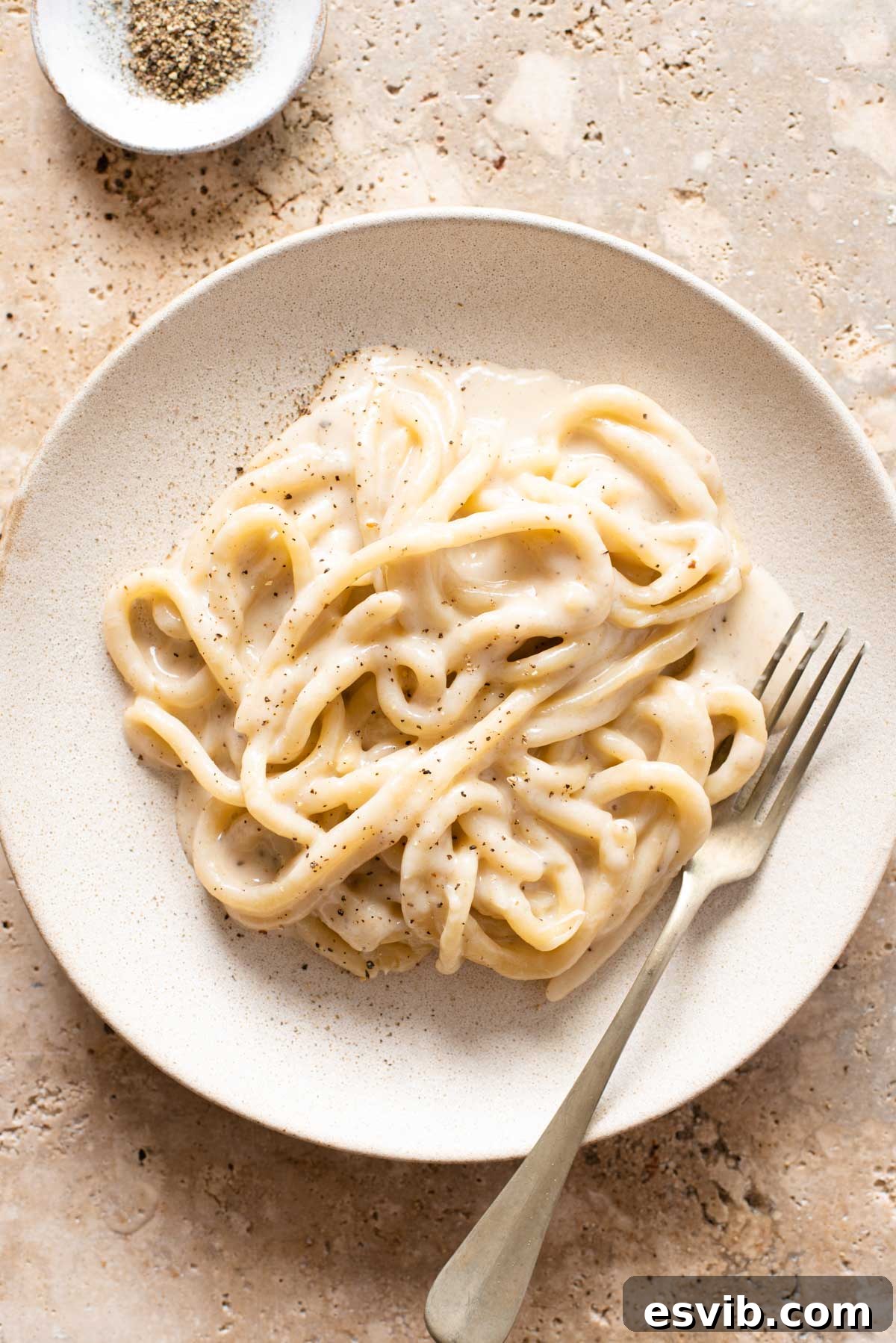
Embark on a culinary journey to the heart of Italy with this definitive guide to crafting an **authentic Cacio e Pepe sauce**. A shining example of Italian culinary brilliance through simplicity, this iconic dish transforms a mere trio of core ingredients into a gloriously **silky smooth, incredibly creamy, and utterly cheesy sauce**. While traditionally enjoyed with spaghetti or tonnarelli pasta in the Eternal City of Rome, our recipe introduces you to the delightful **Pici pasta**, a hand-rolled Tuscan specialty whose rustic charm and satisfying chew beautifully cradle every luxurious strand of this peppery cheese sauce. Prepare to unlock all the essential techniques, expert tips, and insider tricks needed to confidently conquer Cacio e Pepe, ensuring a perfect, restaurant-quality result you’ll be eager to recreate time and time again in your own kitchen!
Unveiling Cacio e Pepe: A Roman Staple with a Tuscan Twist
Cacio e Pepe, which literally translates as ‘cheese and pepper’, holds a revered place among the four quintessential Roman pasta dishes. Alongside its famous cousins – the robust Gricia, the indulgent Carbonara, and the flavorful Amatriciana – Cacio e Pepe epitomizes the elegance of Roman cuisine, proving that extraordinary flavor can arise from the simplest components. Its magic lies in the harmonious interplay of authentic Pecorino Romano cheese, freshly cracked black pepper, and the indispensable, starchy elixir of pasta water. This humble trio, when expertly handled, produces a sauce of unparalleled depth, richness, and profound satisfaction.
Historically, Cacio e Pepe was a simple, nourishing meal for Roman shepherds, made from shelf-stable ingredients carried during their transhumance. The high fat content of Pecorino Romano provided energy, while the pepper offered warmth, making it a perfect, hearty dish. While its traditional Roman renditions typically feature long, thin pastas like spaghetti or the square-cut tonnarelli, Italian culinary traditions are rich with regional adaptations. In the sun-drenched region of Tuscany, particularly in the enchanting city of Siena, this beloved Roman sauce discovers an exquisite partner in Pici pasta. These rustic, thick, hand-rolled strands, traditionally made from just flour and water (without eggs), possess a wonderfully satisfying chew and a delightfully irregular, porous surface. This texture is absolutely ideal for clinging to every drop of the luxurious, creamy Pecorino sauce, offering a unique and utterly charming dining experience. For many, including us, this Tuscan pairing of Pici with Cacio e Pepe has become an absolute favorite way to savor this classic dish, elevating its rustic charm even further.
Despite its remarkably short ingredient list and rapid preparation time, Cacio e Pepe is famously known for being deceptively challenging to master. The seemingly straightforward process often leads to frustrating pitfalls for home cooks. The most prevalent issue, and perhaps the greatest culinary heartbreak, is the dreaded **cheese clumping**, resulting in a separated, grainy sauce instead of the desired smooth emulsion. Achieving that signature silken, cohesive sauce requires not just quality ingredients, but a precise understanding of technique, temperature control, and the science of emulsion. To ensure your journey to Cacio e Pepe perfection is smooth, rewarding, and devoid of culinary mishaps, we wholeheartedly recommend that you thoroughly read through our comprehensive “Expert Tips & Frequently Asked Questions” section before you even begin boiling water. Adhering to these crucial guidelines will empower you to consistently create the creamiest, cheesiest, most aromatic, and irresistibly delicious pasta dish you’ve ever had the pleasure of tasting. Get ready to impress yourself and your guests! Buon Appetito!
Unlock the full potential of this classic dish! Below, you’ll discover our comprehensive notes on ingredient selection, vivid step-by-step photos to guide you, advanced expert tips for success, answers to frequently asked questions, and a helpful video tutorial. For precise ingredient quantities and a convenient, printable recipe card, simply scroll to the very bottom of this page or utilize the direct recipe link provided below.
The Indispensable Ingredients for Authentic Cacio e Pepe
The sublime simplicity of Cacio e Pepe means that the quality and correct selection of its few components are not just important, but absolutely paramount. Each ingredient plays a vital role in achieving the dish’s signature creamy texture and bold flavor. This section delves into what you need and, crucially, explains why specific choices are essential for an authentic and successful outcome, ensuring every bite transports you to Italy.
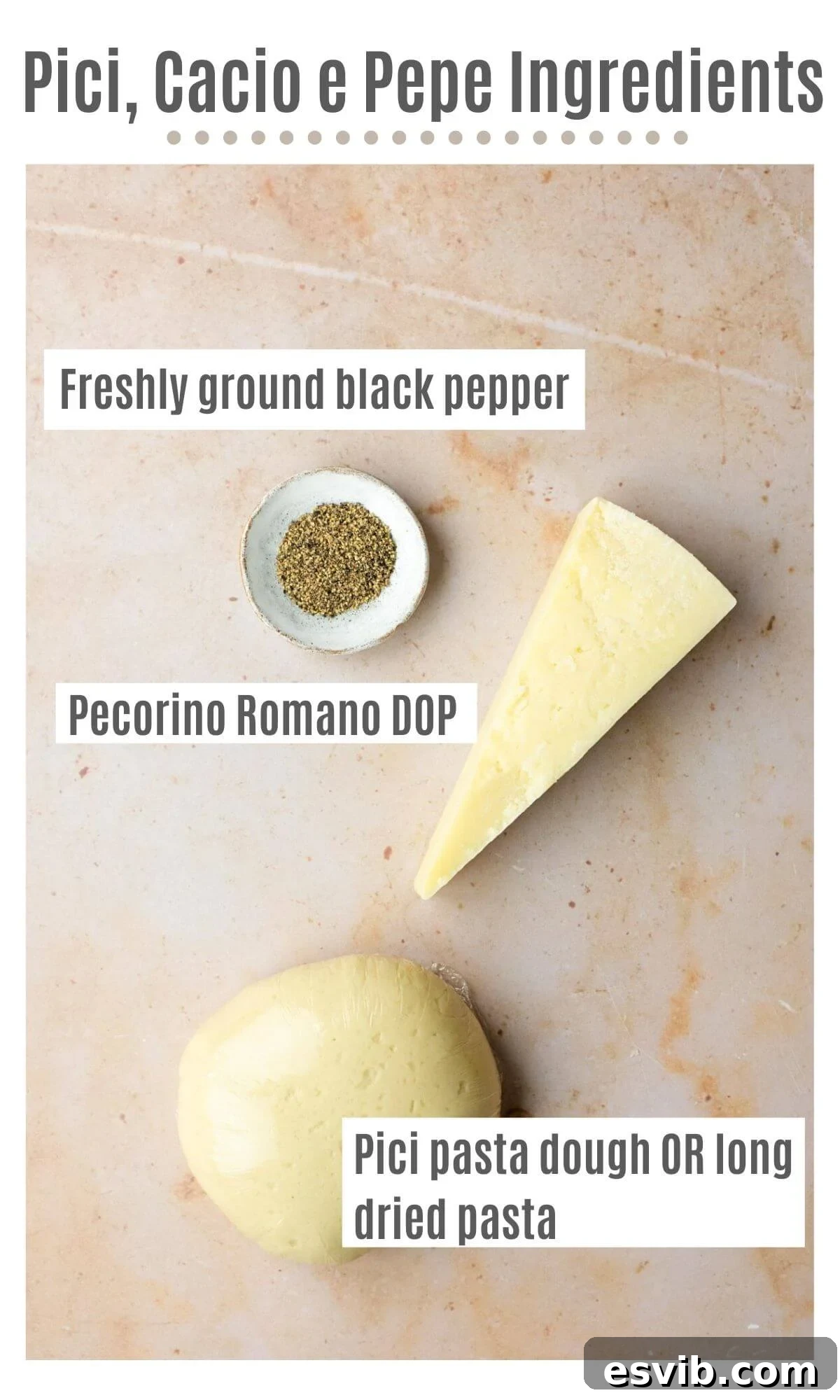
- Pecorino Romano DOP – The Foundation of Flavor and Texture: This is unequivocally the most critical ingredient, and its quality cannot be overstated. You are strongly advised to use **Pecorino Romano DOP (Denominazione d’Origine Protetta)**. The DOP certification is not just a label; it’s a legal guarantee of authenticity, ensuring the cheese is made from 100% sheep’s milk in designated regions (Lazio, Sardinia, or the province of Grosseto in Tuscany) following time-honored traditional methods. This adherence to tradition is crucial because the specific aging process and fat-to-protein ratio of genuine Pecorino Romano DOP are what allow it to emulsify smoothly with pasta water, creating that iconic creamy sauce without clumping. Generic “Pecorino” found in many supermarkets often lacks these precise characteristics and may lead to a grainy or separated sauce. True Pecorino Romano DOP possesses a distinctively sharp, salty, and piquant flavor that is irreplaceable. Look for a cheese with a black or colorless rind clearly stamped with ‘Pecorino Romano DOP’. Your best sources will be Italian delis, specialty food stores, or reputable online retailers. Absolutely avoid substituting with Parmigiano Reggiano or other cheeses; they will fundamentally alter the flavor profile and, more importantly, the sauce’s ability to emulsify properly.
- Freshly Ground Black Pepper – The Aromatic Soul: In Cacio e Pepe, black pepper is far more than a simple seasoning; it is a co-star, providing a delightful spicy kick and a profound aromatic complexity. For optimal flavor release and intensity, it is absolutely essential to use **freshly ground black pepper** from whole peppercorns. Pre-ground, fine pepper powder, often found in shakers, is stale, lacks vibrant flavor, and will offer a flat taste compared to the lively, complex notes released when whole peppercorns are freshly cracked. We recommend a coarse grind – this not only enhances the pepper’s flavor and aroma when toasted but also provides a subtle, pleasing textural contrast in the finished dish. Investing in a good quality pepper mill will truly elevate this aspect of the recipe. Consider seeking out high-quality tellicherry or malabar peppercorns for an even richer aromatic experience.
- Pasta – The Perfect Canvas: The choice of pasta is pivotal as it acts as the vehicle for the sauce. While Cacio e Pepe is versatile with various pasta shapes, our recipe proudly features Pici pasta. These thick, hand-rolled Tuscan noodles, characterized by their rustic, slightly irregular shape and chewy texture, are exceptional at clinging to and absorbing the rich cheese sauce. If you’re feeling adventurous and wish to truly embrace the Tuscan spirit, we highly recommend following our homemade Pici pasta tutorial – it’s a surprisingly quick and easy eggless dough that yields incredibly satisfying results. The rough, porous surface of homemade Pici provides countless nooks and crannies for the Pecorino emulsion to adhere to, making every bite sublime. If homemade Pici isn’t an option, traditional long dried pasta shapes like spaghetti, bucatini, or tonnarelli are excellent and widely accepted choices. Their smooth surfaces still work, but the rustic, artisanal quality of Pici adds an extra dimension of authenticity and pleasure. When choosing dried pasta, opt for a good quality bronze-die extruded pasta, which typically has a rougher surface for better sauce adhesion.
- Salt (for pasta water) – The Unsung Flavor Enhancer: Although not one of the “three ingredients” of the sauce itself, salt is absolutely fundamental for properly seasoning the pasta water. Adequately salted pasta water (it should taste “like the sea”) seasons the pasta from within, which in turn contributes significantly to the overall flavor balance of the final dish. A bland pasta will result in a bland sauce, no matter how perfect the emulsion. However, remember a critical tip: use *less* water than you typically would when boiling pasta to ensure its starch concentration is maximized. This highly concentrated, salty, starchy water is your secret weapon for a stable, creamy emulsion.
Crafting Cacio e Pepe: A Step-by-Step Guide to Perfection
Creating a flawless Cacio e Pepe is an exercise in precision and timing. Follow these meticulously detailed instructions, complemented by crucial visual aids, to achieve that coveted silky, emulsified sauce. Pay close attention to each step, as they are all integral to mastering this Roman classic.
Initial Prep Work for Optimal Success: Your journey to Cacio e Pepe perfection begins with careful preparation. First, place a large pot on the stove and bring generously salted water to a rolling boil. Here’s a foundational tip: deliberately use **less water than you typically would** for cooking pasta. This intentional reduction ensures that the pasta water becomes exceptionally starchy – a non-negotiable component for creating a stable and gloriously creamy emulsion later in the process. While the water is heating, take your Pecorino Romano DOP cheese and finely grate it. The finer the grate, the more quickly and smoothly the cheese will dissolve, significantly reducing the risk of clumping. Transfer the finely grated cheese to a small mixing bowl and set it aside, ready for action.
If you have opted to use **dried pasta**, now is the moment to introduce it to the boiling, salted water. Crucially, you must **undercook it by approximately 2-3 minutes** compared to the package instructions. This deliberate undercooking allows the pasta to finish its cooking process directly in the sauce, where it will absorb the rich flavors and release additional starches, further contributing to the sauce’s creaminess.
Step 1: Toasting the Pepper for Aromatic Revelation: Position a large, dry skillet or frying pan over a medium heat. Add your freshly ground coarse black pepper to the dry pan. Gently toast the pepper for just a few seconds, continuously swirling the pan to ensure even heat distribution and prevent burning. This critical step serves to awaken and intensify the pepper’s complex essential oils, releasing its full, vibrant aroma and bold flavor, which will become the aromatic heart of your sauce. Be vigilant and remove from heat immediately if you smell burning. (Refer to Photo 1 for visual guidance on the appearance of toasting pepper.)
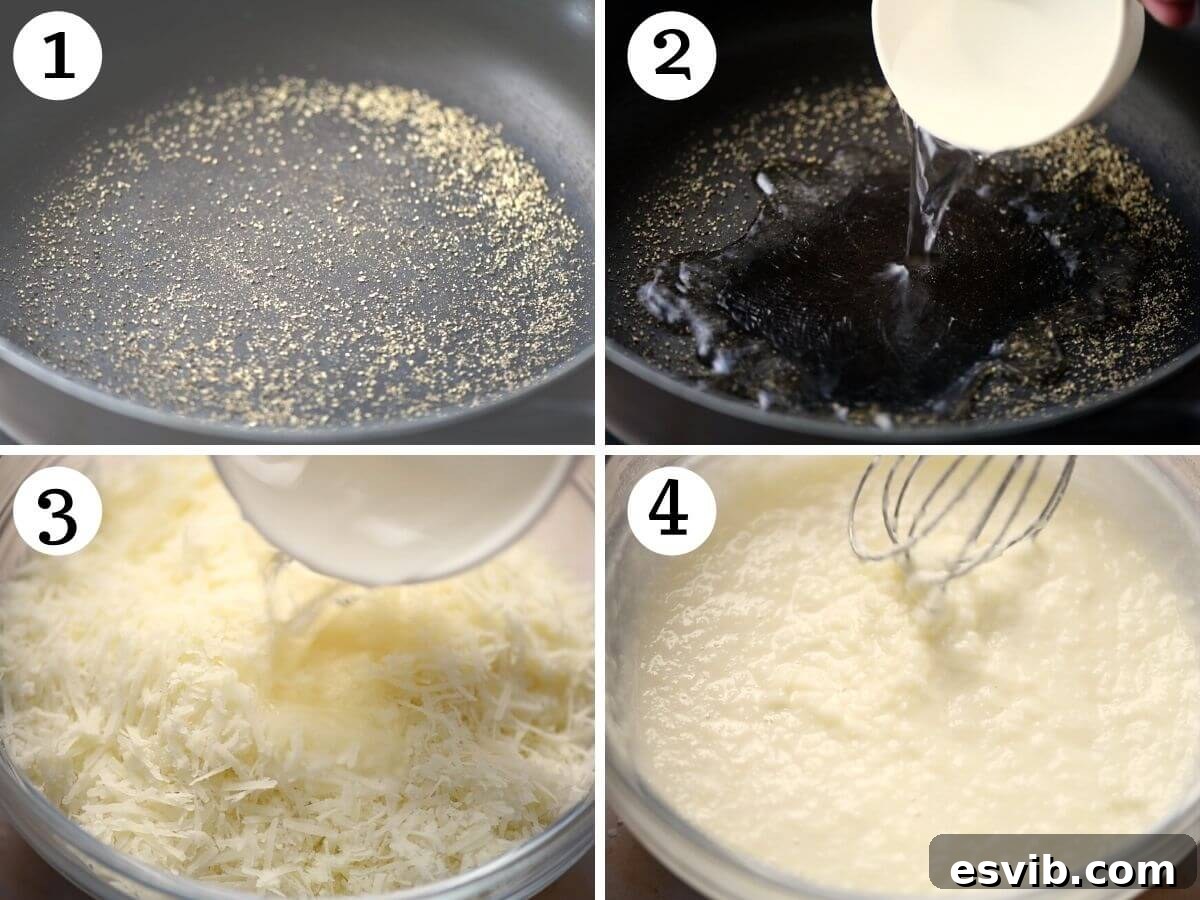
Step 2: Infusing the Starchy Liquid with Pepper: Immediately after toasting the pepper and while the pan is still warm, carefully add about ½ cup (approximately 120ml) of the hot, starchy pasta water to the pan. Allow this peppery liquid to gently simmer. This step allows the toasted pepper’s robust flavor to thoroughly infuse into the starchy water, creating a fragrant, seasoned base that will become an integral part of your finished sauce. Keep this mixture warm and ready as your pasta continues to cook. (Refer to Photo 2, illustrating the pasta water being added to the pepper.)
Step 3: Crafting the Pecorino Paste – The Emulsification Anchor: Now, shift your focus to the bowl of finely grated Pecorino Romano. Crucially, begin to gradually add a few ladles of the hot, starchy pasta water to the cheese. Do this incrementally, adding only a small amount of water at a time, and stir vigorously and continuously with a spoon or whisk. Your objective is to achieve the consistency of a loose, creamy paste – it should be slightly thicker than heavy cream, though it’s important to note it won’t be perfectly smooth due to the nature of the cheese. This pre-emulsification step is absolutely vital as it prevents the finely grated cheese from undergoing a temperature shock and clumping when it is later introduced to the hot pan with the pasta. This is where the magic begins to build. (Refer to Photos 3 & 4 for visual cues on achieving the desired Pecorino paste consistency.)
If you have opted for **fresh pasta**, this is the precise moment to introduce it to the boiling, salted water. Remember that fresh pasta cooks significantly faster than its dried counterpart, so precise timing is paramount here to avoid overcooking.
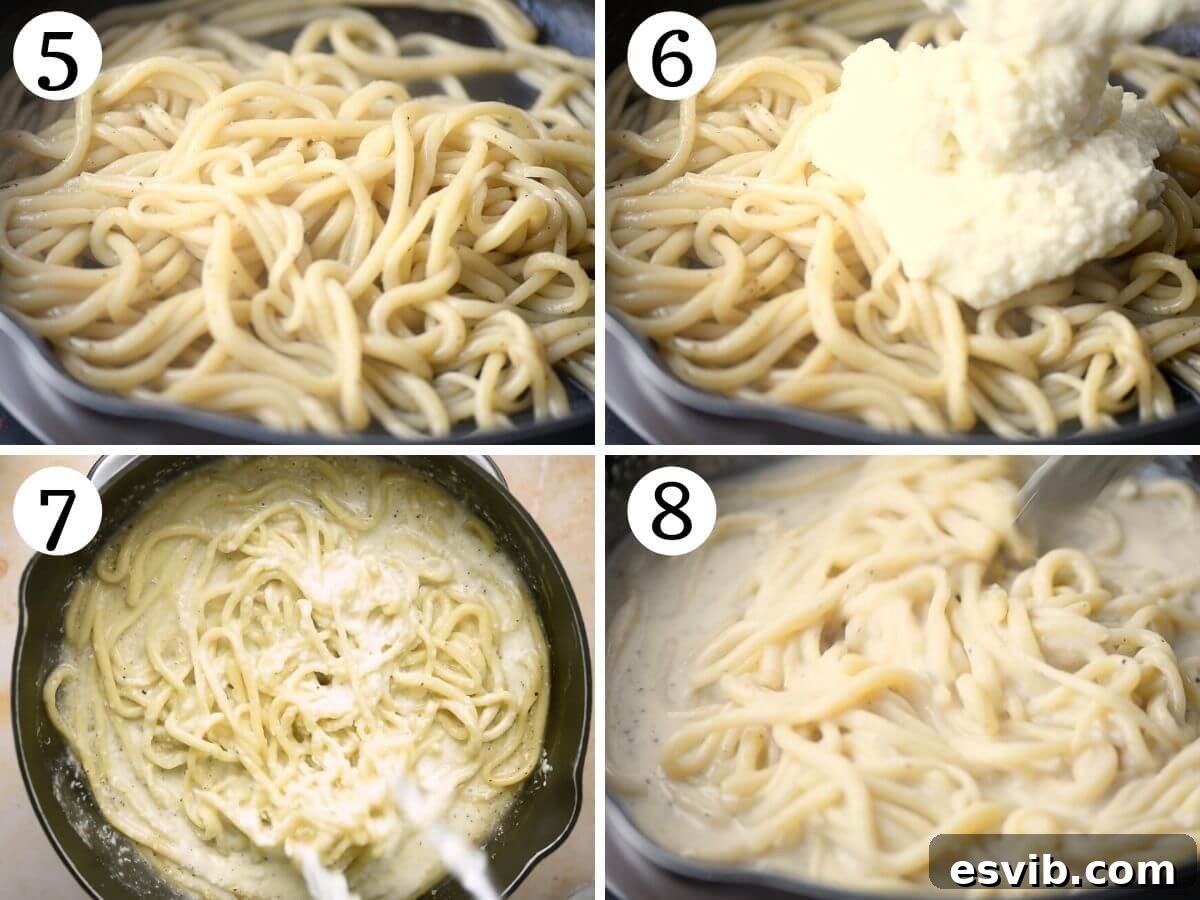
Step 4: Finishing the Pasta in the Flavorful Pan: When your pasta is approximately 2-3 minutes away from reaching the desired al dente tenderness (or just beginning to soften if using fresh pasta), use a pair of tongs to meticulously transfer it directly from its boiling water into the skillet containing the pepper-infused water. **Crucially, avoid draining the pasta in a colander at all costs!** Using tongs ensures that each strand of pasta carries the perfect amount of essential residual starchy water directly into your sauce, which is invaluable for the final emulsion. Stir the pasta gently but continuously in the pan for about 1 minute, allowing it to thoroughly absorb the peppery liquid and release additional starches. If you notice the pan appears too dry or the liquid has significantly reduced, add a small splash more of the hot pasta water from the pot, as needed. (Refer to Photo 5, which illustrates the transfer of pasta into the pan.)
Step 5: The Grand Emulsification – Unveiling the Silken Sauce: This is the climax of your Cacio e Pepe creation, demanding confidence and continuous motion! Immediately turn the heat down to its absolute lowest setting, or, ideally, briefly remove the pan entirely from the direct heat source. Without delay, add the pre-prepared Pecorino paste mixture directly into the pan with the pasta. Now, this is where technique truly matters: stir continuously and vigorously. You’ll observe a transformative process: initially, the sauce might appear to be separating, clumping, or looking slightly grainy – **do not panic! This is a perfectly normal, albeit anxiety-inducing, phase.** Maintain your vigorous stirring, ensuring the pasta, cheese, pepper, and starchy water are constantly in motion. The combination of the pasta’s residual heat, the pan’s warmth, and your persistent stirring will work in harmony to encourage the fats from the cheese and the starches from the pasta to emulsify. This “magic moment” will see the mixture seamlessly transform into a glossy, velvety smooth, and incredibly creamy cheese sauce. Once you achieve that beautiful, saucy, cohesive consistency, immediately turn the heat off completely. Continue stirring for one more minute; this final minute off the heat allows the sauce to thicken slightly and settle into its perfect, luscious consistency. Serve your perfectly crafted Cacio e Pepe immediately and revel in its Roman splendor! (Refer to Photos 6-8 for the mesmerizing transformation of the sauce from separated to silken.)
Expert Tips & Frequently Asked Questions for Cacio e Pepe Perfection
Achieving the revered Cacio e Pepe perfection involves understanding and applying a few key principles. These comprehensive tips and answers to frequently asked questions are designed to empower you, elevate your cooking skills, and help you expertly navigate and avoid the most common pitfalls associated with this classic Roman dish.
- Maximize Starch: The “Less Water” Rule for Pasta! The cornerstone of a truly successful Cacio e Pepe emulsion is the high starch content of your pasta water. To achieve this, consciously fill your pot with less water than you typically would when boiling pasta. This deliberate reduction concentrates the starch released from the pasta as it cooks, creating a potent “liquid gold” that is absolutely essential for effectively binding the Pecorino cheese and black pepper into a stable, creamy sauce. Think of this super-starchy water as a natural thickening agent and emulsifier, directly contributing to the sauce’s luxurious texture.
- Tongs: Your Precision Tool for Pasta Transfer! When the moment arrives to transfer your pasta from the boiling pot to the pan where your sauce is waiting, forgo the colander entirely. Instead, always use a reliable pair of kitchen tongs. This precise technique ensures that each strand of pasta carries just the right amount of residual, valuable starchy water directly into your sauce pan. Draining pasta in a colander removes too much of this precious, starchy liquid, which is detrimental to achieving the perfect emulsion.
- The Mantra: Stir, Stir, Stir – Embrace the Emulsion! The most common, and often disheartening, challenge encountered with Cacio e Pepe is a clumpy, grainy, or separated sauce. To prevent this, when you introduce the cheese mixture to the pan (especially after removing it from direct heat), continuous and vigorous stirring is paramount. It’s entirely normal for the sauce to appear as if it’s splitting or clumping initially – do not lose confidence or panic! This is a natural stage in the emulsion process. Simply continue stirring with conviction for one to two minutes, and you will witness the remarkable transformation as the fats, starches, and liquid magically come together, morphing into a beautifully smooth, homogenous, and incomparably creamy cheese sauce. The constant motion actively aids in binding the ingredients properly.
- Mastering Temperature Control: The Enemy of Clumping! High, uncontrolled heat is the arch-nemesis of a silky Cacio e Pepe sauce, as it can cause the delicate Pecorino Romano proteins to seize, clump, and separate. To avoid this, always add your pre-made cheese paste to the pasta either completely off the direct heat, or with the heat turned down to its absolute lowest setting. The residual heat from the freshly cooked pasta and the warm pan is typically ample to gently melt the cheese and facilitate proper emulsification without “cooking” the cheese into an undesirable, solid mass.
- Finely Grate Your Pecorino: Uniformity for Smoothness! The consistency of your grated Pecorino Romano plays a significant role in the final texture of your sauce. A very fine grate ensures that the cheese melts more rapidly and uniformly into the sauce, dramatically minimizing any risk of stubborn clumps. Utilizing a microplane or the smallest side of a box grater is highly recommended for achieving this ideal, almost powdery, texture.
- Serve Immediately: The Ephemeral Beauty of Freshness! Cacio e Pepe is a dish designed to be enjoyed at the peak of its perfection – the very moment it is finished. The delicate, creamy emulsion is highly sensitive to temperature changes and will inevitably begin to tighten, solidify, and lose its ideal texture as it cools. For this reason, Cacio e Pepe does not reheat well and is absolutely not suitable for freezing, as both processes will severely compromise its sublime texture and flavor. Plan to savor it straight from the pan for the ultimate experience.
For an authentic Cacio e Pepe that boasts its signature creamy texture and distinctive sharp flavor, the answer is a definitive NO. You absolutely must use **Pecorino Romano DOP (Denominazione d’Origine Protetta)**. This specific cheese, meticulously crafted from sheep’s milk and traditionally aged, possesses unique proteins and fats that enable it to emulsify smoothly with starchy pasta water. Substituting with other types of Pecorino or, even worse, Parmigiano Reggiano, will almost certainly result in a clumpy, grainy sauce and will fundamentally alter the traditional, piquant flavor profile of the dish. To ensure success and authenticity, stick strictly to Pecorino Romano DOP.
Yes, absolutely! While we enthusiastically recommend Pici pasta for its incredible texture and superb ability to capture the sauce, you are certainly not limited to it. Traditionally, Roman Cacio e Pepe is most often prepared with classic long pasta shapes such as **spaghetti, bucatini (a thicker, hollow spaghetti), or tonnarelli (square-cut spaghetti)**. These long strands work beautifully as they allow the rich sauce to coat each noodle evenly. You can even venture into short pasta shapes like rigatoni or penne, which are excellent at cupping the sauce within their tubes. However, for your initial attempts at making Cacio e Pepe, we generally suggest beginning with a long pasta shape, as they tend to be a little easier to coat uniformly and achieve that desirable, silky saucy consistency.
Don’t lose hope or throw out your pasta! Cheese clumping or sauce splitting is a common challenge, even for experienced cooks. If this happens, immediately remove the pan from any direct heat. Swiftly add a very small splash (start with just a tablespoon) of extra hot, starchy pasta water to the pan. Then, stir incredibly vigorously, almost whisking, for another 30 seconds to a minute. The sudden temperature adjustment combined with renewed, rapid agitation can often help to re-emulsify the sauce and bring it back to its smooth, creamy state. To minimize this risk in future attempts, always ensure your Pecorino is finely grated and added off direct heat, and that your pasta water is sufficiently starchy.
DOP stands for “Denominazione d’Origine Protetta,” which translates to “Protected Designation of Origin.” This certification is a strict legal guarantee that a food product is genuinely produced in a specific geographical region, using prescribed traditional methods, and adhering to rigorous quality standards. For Pecorino Romano, this means it is made exclusively from sheep’s milk within specific areas of Italy (Lazio, Sardinia, or the province of Grosseto) and aged for a minimum of five months. This controlled production process ensures the cheese develops the precise chemical composition and fat content necessary for it to melt and emulsify perfectly into a stable, smooth Cacio e Pepe sauce. Non-DOP versions often use different milk sources, aging processes, or may even contain additives that can interfere with proper emulsification, leading to a frustratingly granular or clumpy sauce. The DOP guarantees the authentic behavior of the cheese in the recipe.
Explore More Traditional Italian Pasta Recipes You’ll Adore
If the captivating simplicity and profound flavors of Cacio e Pepe have truly captured your culinary imagination, you’re in for a treat as you delve deeper into the rich and diverse world of authentic Italian pasta dishes. Each recipe offers a unique narrative of regional tradition, culinary artistry, and the timeless joy of Italian cooking. Here are more beloved classics, ranging from the Roman repertoire to other regional specialties, to inspire your next delicious kitchen adventure and broaden your appreciation for Italian gastronomy:
- Spaghetti alla Carbonara: Dive into another jewel of Roman cuisine, renowned for its luxuriously creamy sauce crafted from eggs, salty Pecorino Romano, crispy guanciale, and a generous flourish of black pepper. A true masterpiece of balance and flavor.
- Bucatini all’Amatriciana: Experience a robust and intensely flavorful sauce that originates from Amatrice. This classic features tender guanciale, sweet ripe tomatoes, a touch of Pecorino Romano, and a hint of chili for a delightful kick.
- Pasta alla Gricia: Often affectionately referred to as “Amatriciana without tomatoes,” this ancient Roman dish is actually the precursor to Amatriciana. It elegantly highlights the rich flavors of savory guanciale, sharp Pecorino Romano, and pungent black pepper, proving that less can truly be more.
- Pasta Alla Norma (Eggplant Pasta): Transport your taste buds to the sun-drenched island of Sicily with this vibrant and hearty classic. It features tender fried eggplant, a rich and aromatic tomato sauce, fresh basil, and is generously finished with grated salted ricotta cheese.
- Penne Pomodoro (Tomato Basil Pasta): A timeless, universally loved Italian favorite that celebrates the purity of fresh ingredients. This simple yet exquisite dish showcases the bright flavors of ripe tomatoes, fragrant basil, and good quality pasta.
We genuinely hope that you thoroughly enjoy preparing and savoring this **Pici Cacio e Pepe recipe**, and that it brings you immense joy in experiencing such an iconic and flavorful dish. Your culinary journey is important to us, so if you’ve had the pleasure of trying this recipe or any other delightful creation from our blog, please don’t hesitate to take a moment to rate it and share your valuable feedback in the comments section below – we are always thrilled to hear from you and learn about your experiences! Additionally, we invite you to **FOLLOW US** on FACEBOOK, INSTAGRAM, and PINTEREST for daily culinary inspiration, behind-the-scenes glimpses, and engaging content. For even more delicious, carefully curated recipes delivered directly to your inbox every week, consider signing up for our exclusive NEWSLETTER. Let’s continue to explore the wonderful world of Italian cooking together!
Step By Step Photos Above
Most of our recipes come with step by step photos, helpful tips and tricks to make it perfectly first time and even video!
Pici, Cacio e Pepe
By Emily
5 minutes
10 minutes
15 minutes
4
servings
Pin Recipe
Print Recipe
Ingredients
-
1 lb Pici pasta, or other long pasta (450g) -
2.5 cups Pecorino Romano DOP, (200g), finely grated -
1 tsp freshly ground black pepper, coarsely ground -
Salt, for pasta water (to taste)
Instructions
-
Important Note: There are slightly different instructions based on whether you are using fresh or dried pasta. If using dried pasta, begin boiling it at Step 3. If using fresh pasta, begin boiling it at Step 7. This is a very quick recipe once you start, so it is highly recommended to read all instructions thoroughly before you begin cooking.
-
Bring a pot of generously salted water to a rolling boil. Use less water than you normally would for cooking pasta to ensure the water becomes exceptionally starchy. Finely grate the Pecorino Romano DOP and transfer it to a small mixing bowl; set aside.
-
If you are using **dried pasta**, begin boiling it in the salted water now. Cook it approximately 2-3 minutes less than the package instructions indicate, aiming for a very firm al dente.
-
Place the freshly ground coarse black pepper in a large, dry skillet or frying pan over medium heat. Toast the pepper for just a few seconds, gently swirling the pan until fragrant. Be careful not to burn it.
-
After toasting, add ½ cup (approximately 120ml) of the hot, starchy pasta water to the pan with the pepper. Let it simmer gently, allowing the pepper’s flavor to infuse into the water. Keep this mixture warm.
-
To the finely grated Pecorino cheese in the mixing bowl, gradually add a few ladles of hot pasta water, a little at a time. Stir continuously and vigorously until it forms a loose, creamy paste (it should be slightly thicker than heavy cream and won’t be perfectly smooth). This is your cheese emulsion base.
-
If you are using **fresh pasta**, begin boiling it now. Cook until just shy of al dente.
-
When the pasta (dried or fresh) is about 2 minutes away from being fully cooked to al dente, use tongs to transfer it directly from its boiling water into the pan with the pepper-infused water. Do not drain the pasta in a colander. Stir the pasta in the pan for about 1 minute, allowing it to release more starch and absorb the peppery liquid. Add a small splash more pasta water if the pan appears too dry.
-
Next, turn the heat down to its absolute lowest setting or, preferably, remove the pan entirely from the heat. Immediately add the prepared Pecorino paste mixture to the pasta in the pan. Stir continuously and vigorously. At first, the sauce might look like it’s separating or clumping – this is normal! Keep stirring with confidence; the constant motion and residual heat will encourage the cheese, pepper, and starchy water to emulsify into a smooth, glossy, and creamy cheese sauce. Once you achieve the desired silky consistency, turn off the heat completely and continue stirring for one more minute to allow the sauce to thicken perfectly. Serve immediately and enjoy!
Video
Notes
- Utilize Tongs! – When transferring your pasta from the boiling water to the pan, always use tongs instead of draining it in a colander. This crucial step ensures that you carry over the perfect amount of essential starchy water into the pan, which is vital for the sauce’s emulsification.
- Consistent Stirring is Key! – After adding the cheese mixture to the pasta (and with the heat off or very low), continue to stir continuously and vigorously for a full minute or two until a beautifully smooth and creamy cheese sauce forms. It’s common for it to appear separated initially; however, persistence in stirring will bring it together into a perfect emulsion.
- Storage & Freezing Considerations – Cacio e Pepe is a dish designed for immediate enjoyment. Its delicate, creamy emulsion does not hold up well to reheating, and it is absolutely not suitable for freezing, as both processes will significantly compromise its texture and flavor. Plan to savor it fresh from the pan.
Helpful Information for All Recipes
- We consistently use high-quality **extra virgin olive oil** in all our recipes unless explicitly stated otherwise, as it significantly enhances the flavor profile of our dishes.
- For canned or jarred tomatoes of any variety, we exclusively opt for **Cirio or Mutti brands**. Their consistent premium quality and rich, authentic flavor consistently yield the best results in our cooking.
- Unless a specific size is indicated, all vegetables referenced in our recipes are assumed to be of **medium size**.
- All recipes featured on this site have been meticulously tested and developed using a **fan (convection) oven**. Please be aware that cooking times may vary if you are using a conventional oven.
- For transparency, you can find more detailed information about how our nutrition information is calculated, and note that these values should be used as approximations only.
- Discover our curated list of must-have Italian Pantry Staples to stock your kitchen for authentic and flavorful cooking at any time.
- Explore our comprehensive guide to all our Essential Kitchen Tools for Italian Cooking, ensuring you have the right equipment for every culinary endeavor.
Nutrition
Carbohydrates: 87g |
Protein: 31g |
Fat: 15g |
Saturated Fat: 9g |
Polyunsaturated Fat: 1g |
Monounsaturated Fat: 4g |
Cholesterol: 52mg |
Sodium: 607mg |
Potassium: 303mg |
Fiber: 4g |
Sugar: 3g |
Vitamin A: 210IU |
Calcium: 558mg |
Iron: 2mg
Nutrition information is automatically calculated, so should only be used as an approximation and is based on a single serving.
Did you try this recipe?
Leave a comment below!