
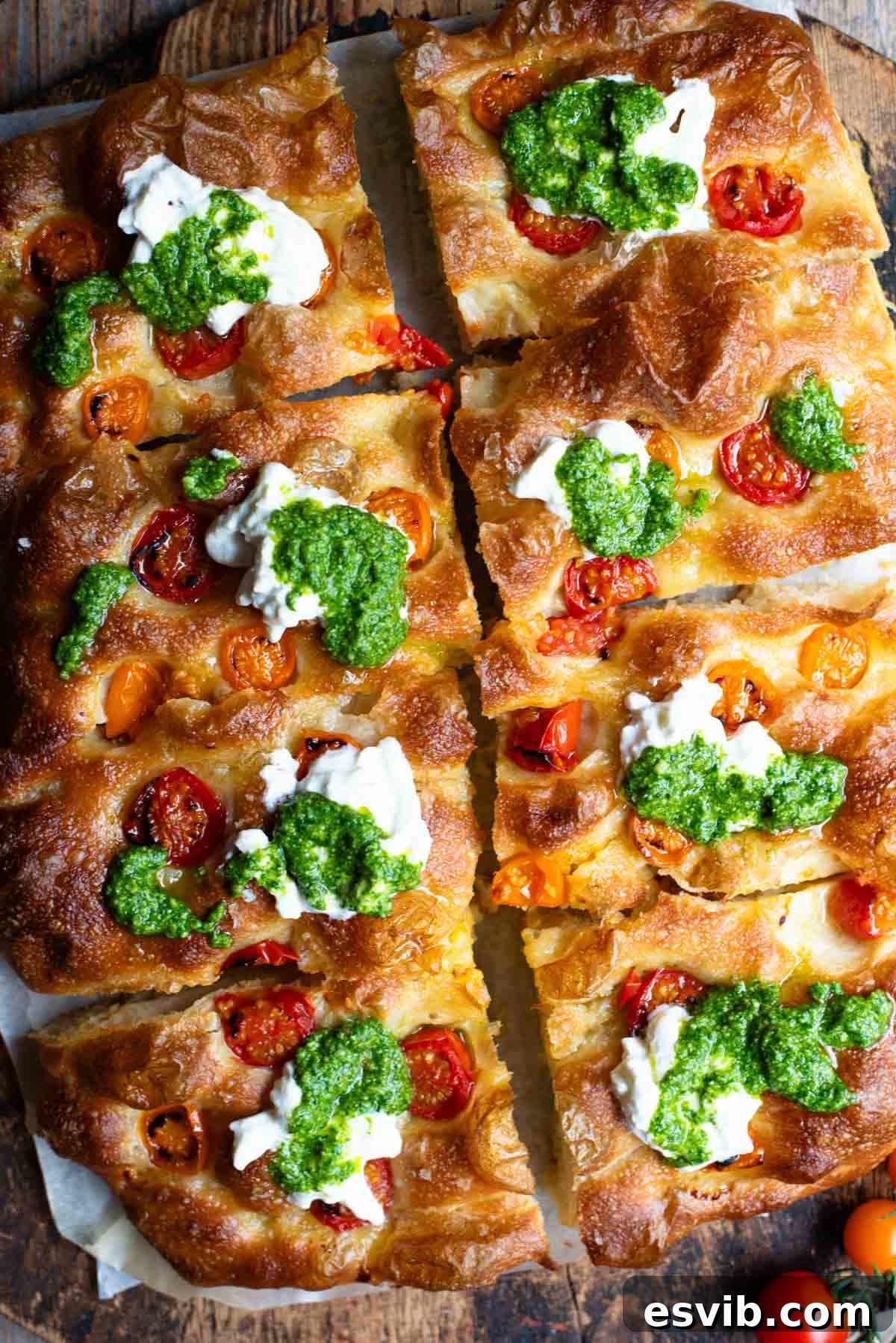
Roasted tomato focaccia, finished with generous spoonfuls of homemade basil pesto and creamy burrata, makes an irresistible loaf. Using an easy no-knead focaccia dough, this bread turns out light and airy with a crisp, golden crust. The combination of slowly roasted tomatoes, bright pesto and rich burrata elevates a simple focaccia into a dinner centerpiece or a casual sharing plate.
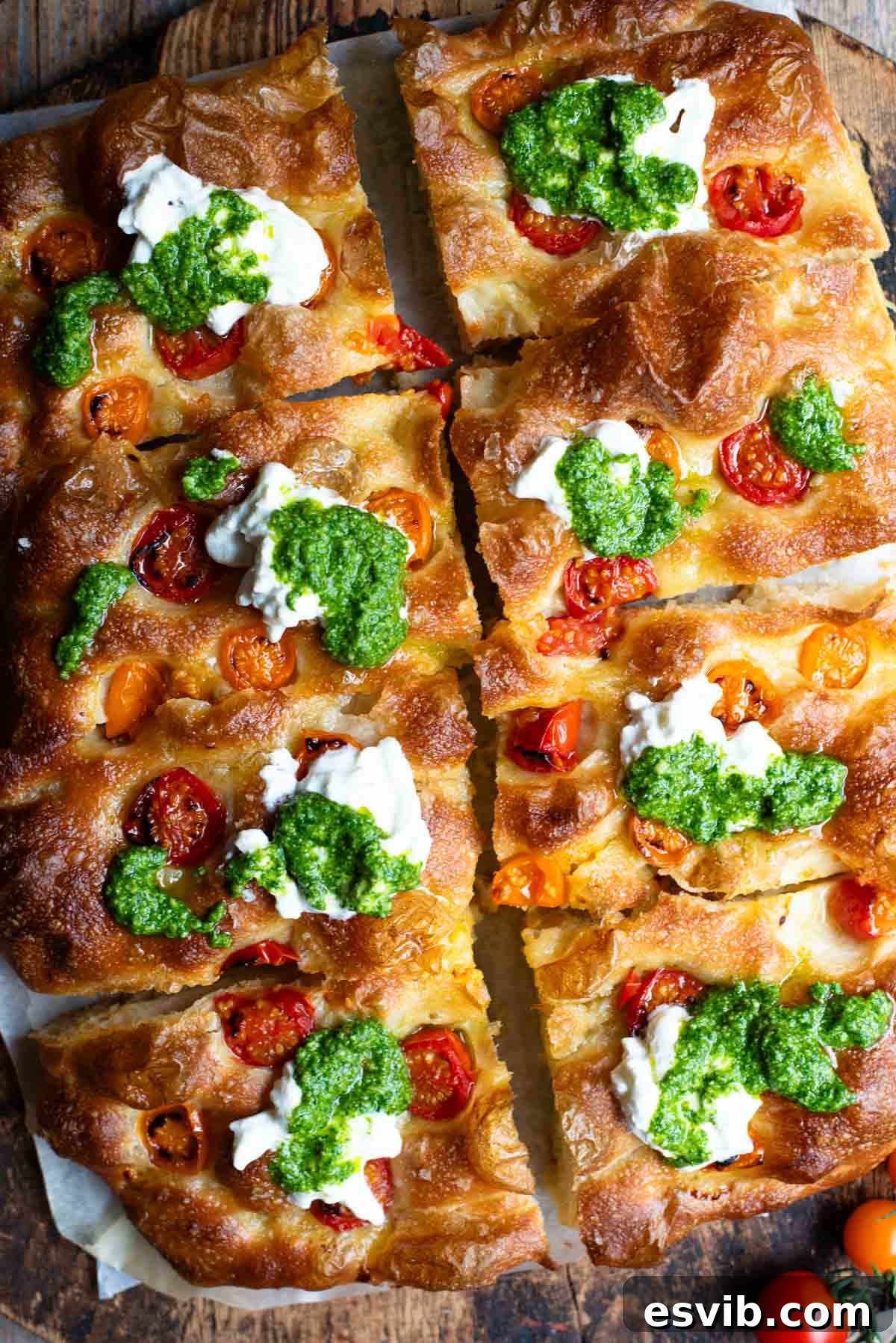
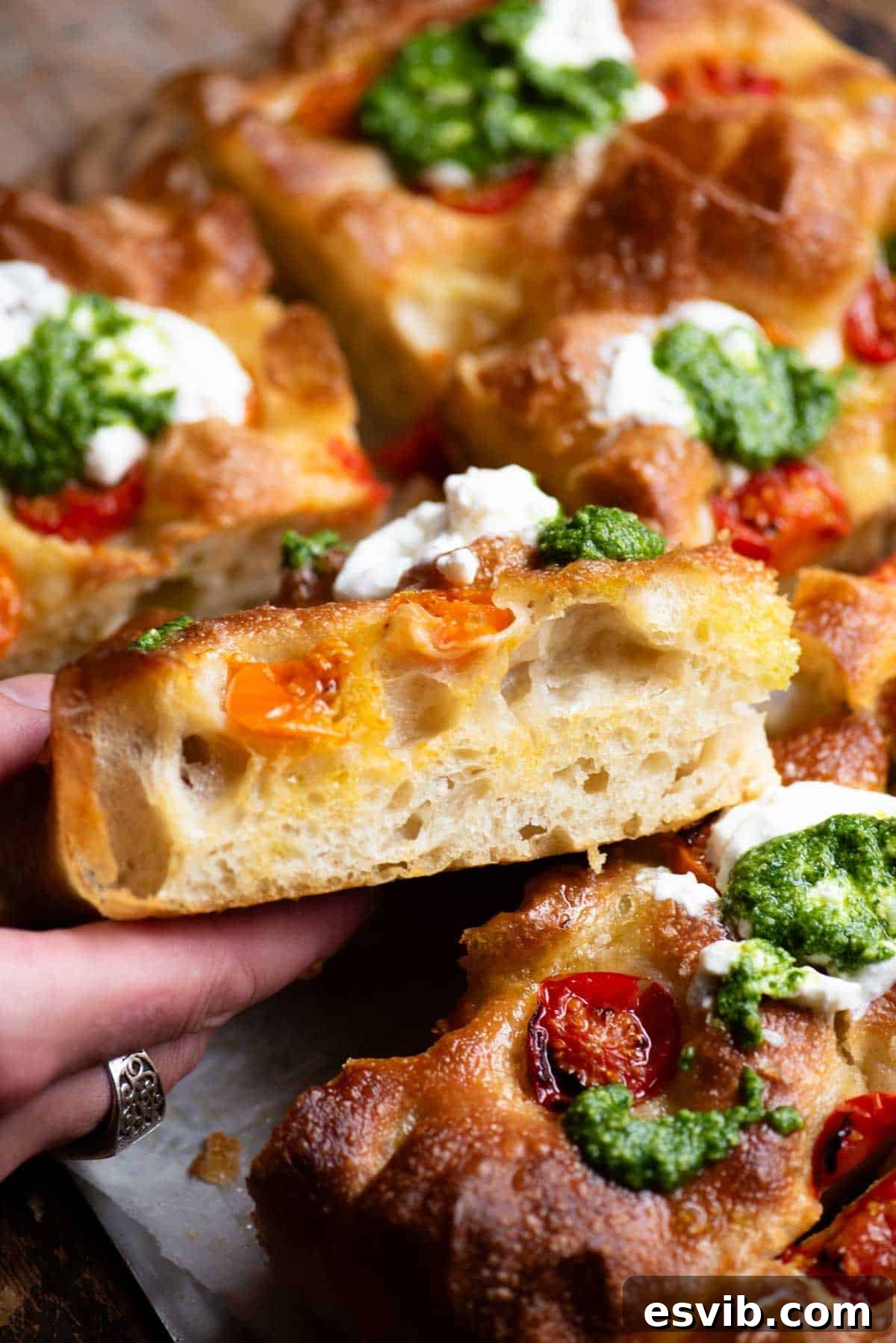
We bake focaccia regularly because it’s straightforward to make, highly versatile and always well received. The dough requires minimal active work — a few stretch-and-folds instead of intensive kneading — and it rewards you with an airy interior and a chewy crumb.
For sandwich-style focaccia I often keep the topping simple: herbs such as oregano or fresh rosemary work beautifully. Sliced and served on its own, however, invites more imaginative toppings. One of our favourites is cherry tomato with anchovies; this roasted tomato version topped with pesto and burrata is another family favourite that’s fresh, vibrant and indulgent in equal measure.
The dough is intentionally easy: no kneading, only a few timed stretch-and-folds. If you prefer, watch the step-by-step photos or a short technique video that demonstrates the folds — it’s simpler than it sounds. For best flavour and structure, prepare the dough a day ahead and allow it to proof in the fridge overnight.
Ingredient notes
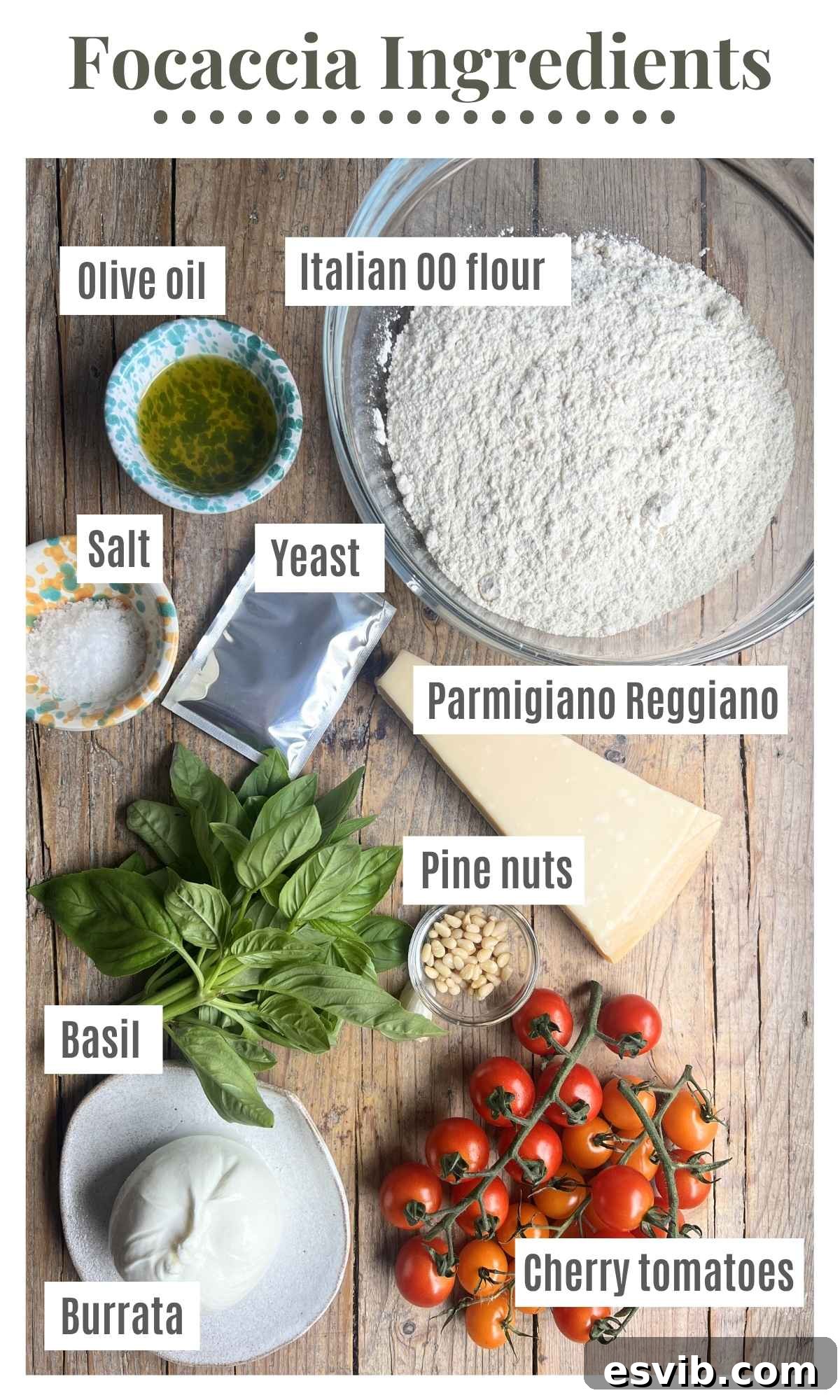
- Italian 00 flour or bread flour: either will work. Aim for a flour with at least 12% protein to achieve the characteristic airy crumb and pleasant chew of focaccia.
- Yeast: instant (rapid) yeast is convenient because it can be mixed directly into the flour. If your yeast requires activation, use a small portion of the recipe water to bloom it first and then proceed.
- Pesto ingredients: fresh basil, pine nuts, garlic, Parmigiano Reggiano and olive oil make a classic pesto. Pine nuts can be swapped for walnuts or pistachios; Pecorino can replace Parmigiano for a sharper flavour.
- Cherry tomatoes: a mix of red and orange cherries looks attractive and provides a range of sweetness and acidity.
- Burrata: the creamy stracciatella inside burrata is ideal, but you can use stracciatella on its own or even fresh ricotta as an alternative.
Recipe tips
Make your own pesto: homemade pesto has far more depth and freshness than jarred versions, and it takes only a few minutes to blend in a food processor or with an immersion blender.
Check your yeast: read the yeast packet. Some dried yeasts need activation in water; others can go straight into the flour. Adjust the method accordingly.
Watch proofing times: proofing depends on room temperature. In warm conditions the dough may double in 1.5–2 hours; in cool kitchens it can take 3–4 hours or longer. Use the dough’s volume, not the clock, as your guide.
If your yeast requires activation, dissolve it in a small amount of the recipe water following the packet instructions, allow it to froth, then add it to the flour along with the remaining water.
Other pesto options
If you want to vary the flavour of the focaccia, several alternative pesto recipes pair wonderfully with roasted tomatoes and creamy cheese. A few favourite variations include:
- Arugula pesto — adds a peppery edge.
- Sun-dried tomato pesto — very umami and rich.
- Parsley pesto — a bright, herbaceous alternative to basil.
- Pistachio pesto — nutty and luxurious with tomatoes and burrata.
More focaccia recipes to try
Bread & Savory Bakes
Cherry Tomato Focaccia with Anchovies and Oregano
Pizza
Focaccia Pizza
Bread & Savory Bakes
Walnut Focaccia
Bread & Savory Bakes
Easy Overnight No Knead Focaccia
If you make this Roasted Tomato and Pesto Focaccia or try any recipe from the collection, please rate it and leave a comment to share how it turned out — feedback is always welcome. You can follow the authors on social channels or sign up for the newsletter to receive new recipes and updates.
Step-by-step photos are available above.
Most recipes include photos, tips and a technique video to help you achieve the best results.
Tomato Focaccia with Pesto and Burrata
By Emily

Equipment
- 14×11 inch baking tray (or similar size)
- Baking parchment
Ingredients
For the dough
- 500 g Italian 00 flour or bread flour (approx 3 3/4 cups, spooned and levelled)
- 400 ml water (1 and 2/3 cups)
- 1 g (1/4 teaspoon) instant yeast (see notes)
- 4 tablespoons olive oil, plus 4–6 tablespoons for greasing and topping
- 7 g (1 level teaspoon) fine salt, plus sea salt flakes for topping
For the pesto
- 30 g fresh basil (about 2 packed cups)
- 15 g (about 2 tablespoons) pine nuts
- 1 garlic clove
- 25 g Parmigiano Reggiano (about 1/4 cup finely grated)
- 45 ml (3 tablespoons) olive oil
- Salt, to taste
For the topping
- 15 cherry tomatoes, halved
- 1 ball burrata
- Olive oil, for drizzling
- Sea salt flakes
Instructions
- Place the flour in a large mixing bowl and sprinkle the yeast and salt at opposite sides of the bowl. If your yeast requires activation, dissolve it in a little water first following the packet instructions.
- Add the water and 4 tablespoons olive oil, then stir with a spoon until no dry flour remains. The dough should be very wet and sticky.
- Cover the bowl and rest for 30 minutes.
- Wet your hands and perform a simple fold: fold each edge of the dough toward the centre. Re-cover and rest for another 30 minutes. Repeat this fold once more and rest again.
- Perform a coil fold: pick the dough from the centre, stretch it upwards until the edges begin to release, then let it fold back. Repeat 3–4 times until the dough can be lifted from the bowl without tearing. Return the dough to the bowl, let it rest 30 minutes, and repeat these coil folds two more times with 30-minute rests.
- Cover and leave the dough to proof until doubled in size, about 2–4 hours depending on room temperature. Once doubled, refrigerate overnight or up to 48 hours for flavour development.
- The next day, line a 14×11 inch tray with parchment. Drizzle a little olive oil under the parchment so it adheres, then drizzle another 2–3 tablespoons on top.
- Remove the dough from the fridge and tip it into the tray. Fold the long ends over each other, then turn the dough seam-side down. Drizzle with more oil, cover, and proof until doubled (1–3 hours).
- Preheat the oven to 230°C (450°F). Oil your fingers and create dimples all over the dough without deflating any large air bubbles.
- Arrange cherry tomato halves on top, cut side up, pressing them gently into the dough. Sprinkle with sea salt and drizzle with olive oil. Bake for 20–25 minutes until golden and crisp.
To make the pesto
- Combine basil, pine nuts, garlic, Parmigiano and olive oil in a food processor or use an immersion blender. Blend to a smooth consistency and season with salt to taste.
- When the focaccia is baked, remove it from the oven and, if desired, drizzle with a little extra olive oil. Allow it to cool at least 15 minutes, then top with spoonfuls of burrata and dollops of pesto. Serve warm or at room temperature.
Notes
- Use a kitchen scale: weighing ingredients, especially flour, improves consistency and accuracy.
- Storage: this focaccia is best the same day. To keep leftovers, allow the loaf to cool, then wrap in foil to preserve freshness.
Helpful info for all recipes
- Extra virgin olive oil is used unless otherwise stated.
- When using canned or jarred tomatoes, choose high-quality brands for better flavour.
- All vegetables are medium sized unless specified.
- Recipes are developed using a fan (convection) oven unless noted.
- Nutrition information is calculated automatically and should be used as an approximation.
Nutrition
Carbohydrates: 36 g |
Protein: 11 g |
Fat: 24 g
Nutrition information is approximate.
Did you try this recipe?
Leave a comment below — I love hearing how your baking turned out!